
Fine-Tuning is Dead: Why Context Orchestration Won in 2026
Last Updated on May 29, 2026 by Editorial Team
Author(s): Mehul Ligade
Originally published on Towards AI.
Fine-Tuning is Dead: Why Context Orchestration Won in 2026 | M009
📍 Abstract
Every few months, something in AI gets declared dead. Prompt engineering. RAG. Transformers. And now, fine-tuning.
Here is the honest answer: fine-tuning is not dead. But the problem it was solving — “how do I get this model to know and do the right things?” — has a better solution now. And the sooner you understand that distinction, the faster you stop building systems that break the moment the world changes.
This article is not another hot take. It is not a LinkedIn post dressed up as a technical guide. It is what I wish I had read before I made expensive decisions in the wrong direction.

If you have ever wondered whether to fine-tune or just “engineer the context better” — and felt genuinely confused about what the right answer was — this is for you.
📘 Contents
- Why “Fine-Tuning is Dead” is Both Wrong and Right
- The Question Nobody Asks Before They Start
- Form vs Facts — The Distinction That Does 80% of the Work
- What Context Orchestration Actually Is
- The Four Layers of Context Every Production System Needs
- Why 1M-Token Windows Changed the Math — But Not Everything
- The Hidden Costs Nobody Puts in Their Blog Post
- Context Poisoning — The Failure Mode Nobody Talks About
- A Decision Framework You Can Actually Use
- When Fine-Tuning Still Wins (It’s a Smaller Case Than You Think)
- What Most Beginners Misunderstand About Both Approaches
- What I Would Tell Someone Starting a New AI Product Today
- What Comes Next in This Series
🔴 Why “Fine-Tuning is Dead” is Both Wrong and Right
Let me start by saying something that will frustrate people on both sides.
Fine-tuning is not dead. And also, most teams should stop reaching for it as their first answer.
Both of those sentences are true at the same time. And the reason people argue endlessly about this topic is that they are never talking about the same problem.
The people saying fine-tuning is dead are usually reacting to how it was being overused — as a hammer for every nail, including nails that did not need hammering. They are right about the overuse. They are wrong to declare the tool useless.
The people defending fine-tuning are usually defending a legitimate use case — one where you genuinely need to change the model’s behavior at a fundamental level. They are right about the use case. They are wrong to ignore how narrow that use case actually is in practice.
The real question is not whether fine-tuning is alive or dead. The real question is: what problem are you actually trying to solve?
That question, asked honestly, will answer the fine-tuning debate before you ever open a training script.
🔴 The Question Nobody Asks Before They Start
I have seen this pattern more times than I can count.
A team builds a prototype. The model works well on generic tasks. But it keeps drifting — wrong tone, wrong format, hallucinated facts about the product, outputs that miss the point by just enough to matter. So someone says, “We need to fine-tune.”
And they do. Weeks of work. Training runs. Evaluation loops. A frozen model checkpoint tied to a specific dataset version.
Three months later, the product changes. The docs update. The tone guide shifts. And now the fine-tuned model is confidently wrong about things that changed after its training cutoff.
I have been in that room. I have been that person.
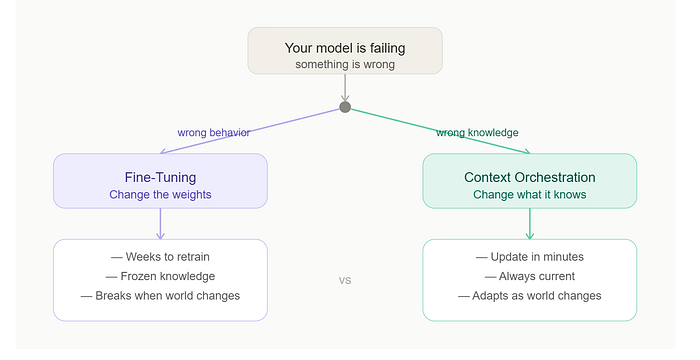
What nobody asked at the beginning was this: Is this model failing because it doesn’t know something — or because it doesn’t know how to behave?
That distinction is everything. And it is the foundation of understanding why context orchestration won.
🔴 Form vs Facts — The Distinction That Does 80% of the Work
Before you write a single line of training code, ask yourself two questions.
Question one: Is your problem about form? Form means behavior. Tone. Output schema. Reasoning style. How the model structures its responses. Whether it sounds like your brand or like a generic assistant. Whether it refuses certain things, formats JSON a specific way, or follows a multi-step reasoning protocol.
Question two: Is your problem about facts? Facts mean knowledge. Product documentation. Internal policies. Last week’s pricing. Customer history. Domain-specific information that the base model simply does not have — and that changes over time.

This single distinction does most of the work.
Facts that change belong in retrieval, not in weights.
Why? Because when you bake facts into model weights, you are making a permanent decision about temporary information. You are freezing what should be fluid. Every time the facts change — and they will — you need another training run. Another evaluation cycle. Another deployment.
Form that is stable — where you have genuinely decided how the model should behave across all cases, and that behavior is unlikely to shift — is a real candidate for fine-tuning. Because behavior that lives in weights is consistent. It does not depend on a retrieval system being available. It does not need to be re-engineered every time a new user query arrives.
Stable form → fine-tuning is a conversation worth having. Changing facts → context orchestration is almost always the answer.
The mistake most teams make is treating “our model gives wrong answers” as a form problem. Usually, it is a facts problem. And baking a facts problem into weights is just an expensive way to lock in a decision you have not actually finished making.
🔴 What Context Orchestration Actually Is
Here is where I want to be precise — because this term gets thrown around loosely and that loose usage causes confusion.
Context orchestration is not just “writing a better system prompt.” It is not just RAG. And it is not just stuffing more documents into a long context window.
Context orchestration is the systematic design of everything that flows into a model’s context window at inference time — to give the model exactly what it needs to do its job well, assembled dynamically, from the right sources, in the right order.
Think of it like this. A base model is a brilliant generalist with no memory. Left alone, it knows a lot about the world in general and nothing about your specific situation. Context orchestration is the system that briefs this generalist before every single conversation — pulling the right files, loading the right memory, injecting the right instructions, and routing the right tools — so that by the time the model starts generating, it has everything it needs.
The model does not change. What changes is what it knows, right now, for this specific task.
That is a fundamentally different architecture from fine-tuning. And in 2026, for most real-world AI products, it is the architecture that wins.
🔴 The Four Layers of Context Every Production System Needs
This is where most articles stop being useful. They define the concept and leave you with nothing to build.
I want to go deeper.
A well-designed context orchestration system has four distinct layers. Each one solves a different part of the problem. Ignore any of them, and your system will have a hole that shows up at the worst possible moment.
Layer 1: Instructions
This is the layer people are most familiar with. It is the system prompt — the behavioral contract between you and the model. It defines who the model is, what it should and should not do, how it should format responses, and what constraints it must respect.
Most teams build this layer. Most teams also underengineer it. A good instructions layer is not a paragraph. It is a structured specification. It handles edge cases explicitly. It gives the model a decision rule for ambiguous situations, not just a vague direction.
Think of it like onboarding a new employee. You do not just say “be helpful.” You give them the handbook, the escalation protocol, the tone guide, and the list of things they should never say to a customer.
If your instructions layer is weak, no amount of retrieval or memory will save you. The model will behave inconsistently, and you will spend weeks debugging what is actually a prompt architecture problem.
Layer 2: Retrieval
This is the layer that solved the facts problem. Instead of baking knowledge into weights, you maintain a knowledge base that the system queries at inference time.
A user asks about your return policy. The system retrieves the current policy document — the one updated last Tuesday — and injects it into the context. The model reads it and answers accurately.
Your model never needed to “know” the return policy in its weights. It needed access to the right document, at the right moment, with enough context to use it correctly.
In 2026, retrieval has matured significantly. Hybrid search — combining dense vector similarity with sparse keyword matching — consistently outperforms pure vector search on real production queries. Reranking models push relevant documents to the top of the retrieved set. Chunking strategies have become more sophisticated, moving from fixed-size splits to semantic and structural chunking that respects document meaning.
But retrieval still has a fundamental vulnerability: it only finds what exists. If the answer is not in the knowledge base, retrieval returns the wrong documents, and the model hallucinates confidently with false grounding. A retrieval system that gives the model a document that seems relevant but is actually misleading is, in some ways, worse than no retrieval at all — because now the model has a bad source to cite.
This is why the retrieval layer alone is never enough. You need the other three layers working alongside it.

Layer 3: Memory
This is the layer most people skip — and it is the one that makes the difference between a system that feels stateless and robotic versus one that feels genuinely intelligent.
Memory in a context orchestration system is not the model’s training data. It is structured information about the specific user, task, or conversation — stored externally and retrieved selectively.
There are three kinds of memory worth understanding.
Short-term memory lives in the current context window. It is the conversation history, the recent tool outputs, the documents already retrieved in this session. It is ephemeral. It disappears when the session ends.
Long-term memory persists in an external store — a vector database, a key-value store, a structured database — and gets retrieved at the start of each session. This is where you store things like user preferences, past interactions, account-specific facts, and session summaries. This is what makes a system feel like it remembers you.
Working memory is the structured state that gets built up during a multi-step task — the intermediate outputs, the decisions already made, the context accumulated across multiple tool calls. This is what makes agentic systems capable of reasoning across long horizons without losing track of what they were doing.
Most production AI systems in 2025 had short-term memory and basic retrieval. The systems winning in 2026 have all three. That is not a small gap. It is the difference between a chatbot and a system that genuinely understands its own context.
Layer 4: Tools and Routing
The fourth layer is the one that separates context orchestration from context injection.
A model that can only read what is in its context is powerful. A model that can also call tools — search the web, query a database, run code, call an API, trigger an action — is a different category of system entirely.
But tools without routing are chaos. Routing is the logic that decides which tool to call, when to call it, what to pass to it, and what to do with the result. A well-designed routing layer is essentially the nervous system of an agentic AI product.
The quality of your routing logic determines the ceiling of your system. A model with access to ten tools and poor routing will be slower, more expensive, and less accurate than a model with access to three tools and clean routing. More is not better. More with structure is better.
This is one of the reasons orchestration frameworks like LangGraph, LlamaIndex, and custom multi-agent architectures have become so central to serious AI engineering in 2026. They are not just convenience wrappers. They are the infrastructure for routing logic that would otherwise be tangled spaghetti code.
🔴 Why 1M-Token Context Windows Changed the Math — But Not Everything
In 2024, context windows were still a meaningful constraint. GPT-4 Turbo offered 128k tokens. Claude 3 pushed further, but at a cost that made naive stuffing impractical. The scarcity of context space forced teams toward retrieval architectures simply because they had no other choice.
That constraint has eased dramatically.
Models in 2026 — Claude Opus 4.6, Gemini 3 pro, and others — support context windows of 1M tokens or more, at pricing points that make long-context applications economically viable for the first time.
This is genuinely significant. It means that for many tasks, you can now pass entire knowledge bases, entire codebases, or entire document sets directly into the model’s context — without needing a retrieval layer at all.
But here is what the “RAG is dead” crowd gets wrong.
A larger bucket does not eliminate the need to choose what goes in the bucket.
If you have 100,000 documents and a 1M-token context window, you still cannot fit everything. You still need selection logic. You still need to decide what is relevant. And as context windows grow, the challenge shifts from “how do I fit more?” to “how do I make sure the model attends to the right things in a sea of content?”
Research has consistently shown that models exhibit what is called the “lost in the middle” effect — where information placed in the middle of a very long context is retrieved less reliably than information placed at the beginning or end. A 1M-token window does not fix this. It makes it a larger problem.
Large context windows are a powerful tool. They are not a substitute for thoughtful context design. The teams winning with long context in 2026 are not the ones stuffing everything in. They are the ones who understand which signals belong near the top, which belong in retrieval, and which belong in external memory.
🔴 The Hidden Costs Nobody Puts in Their Blog Post
When people debate fine-tuning versus context orchestration, they usually compare accuracy numbers. They rarely compare the full cost of each approach.
Let me put it plainly.
Fine-tuning costs: Training compute (often thousands of dollars for serious runs), a curated and labeled dataset (which takes weeks to build and validate), an evaluation framework that can actually detect regressions, an ongoing maintenance burden every time the underlying model updates, and the opportunity cost of being frozen to a specific knowledge snapshot.
The hidden cost nobody talks about is iteration speed. When you fine-tune, you commit. Changing behavior requires another training run. In a product that is evolving quickly — and in 2026, every serious AI product is evolving quickly — that cycle time is brutal.
Context orchestration costs: Retrieval infrastructure (vector databases, chunking pipelines, embedding models), latency on retrieval calls, the engineering work of building a memory layer, and the ongoing discipline required to maintain a high-quality knowledge base.
The hidden cost nobody talks about is context quality. A context orchestration system is only as good as what you put in it. Bad documentation, inconsistent chunking, and poor retrieval precision all degrade output quality in ways that are invisible until they are not.
Neither approach is free. But the flexibility profile is dramatically different.
With context orchestration, you can update behavior today. Push a new document. Change an instruction. Add a routing rule. No training required. No deployment freeze.
With fine-tuning, you are buying consistency at the cost of adaptability.
In a fast-moving product, adaptability is almost always worth more than consistency.
🔴 Context Poisoning — The Failure Mode Nobody Talks About
I want to spend time on something that barely gets mentioned in the literature — because I have seen it break production systems in ways that were embarrassing to diagnose.
Context poisoning is what happens when your context orchestration system injects information that actively misleads the model.
It sounds obvious when you say it. But it is surprisingly easy to build.
Imagine a retrieval system that embeds your product documentation. A user asks a question. The retrieval layer finds three documents that are semantically similar to the query — but one of them is an outdated policy document from fourteen months ago that contradicts the current policy. The model reads all three. It tries to reconcile them. It cannot. So it hallucinates a synthesis that is wrong in a specific, confident, and hard-to-detect way.
This is not a retrieval failure in the traditional sense. The document that caused the problem had high similarity to the query. It “belonged” in the context by any reasonable embedding metric. But it was wrong. And putting it in the context was worse than not retrieving at all.
Context orchestration done badly does not just fail to help. It actively hurts.
The solutions are real but require engineering discipline. Document versioning with explicit deprecation. Metadata filtering so that outdated documents are excluded regardless of similarity score. Confidence thresholds that flag low-certainty retrievals rather than injecting them blindly. And regular audits of what is actually getting retrieved for the queries your users are actually sending.

This is one of the reasons I say context orchestration is not simpler than fine-tuning. It is different. It has its own failure modes. The teams building robust systems in 2026 are the ones who understand those failure modes and design for them from the start — not the ones who discovered them in production.
🔴 A Decision Framework You Can Actually Use
After everything above, here is how I actually make this decision when I start a new project.
Step 1: What is wrong? Is the model giving incorrect facts — things that are wrong because it does not have the right information? That is a retrieval problem, not a fine-tuning problem. Is the model behaving inconsistently — right tone sometimes, wrong tone other times, inconsistent output format? That is an instructions layer problem, not a fine-tuning problem. Is the model reasoning in a fundamentally wrong way — not just giving wrong answers but approaching the problem incorrectly? That might be a fine-tuning conversation.
Step 2: How stable is the fix? If the correct behavior changes frequently, fine-tuning is not the answer. You will be retraining constantly. If the correct behavior is settled, documented, and unlikely to change for at least a year — fine-tuning starts to make sense.
Step 3: What is the cost of being wrong? If a wrong answer costs a customer a bad experience, context orchestration with good retrieval and memory is usually enough. If a wrong answer costs a medical diagnosis, a legal decision, or a financial commitment — you need both. Good context orchestration and fine-tuning on behavior, with heavy evaluation on top.
Step 4: What does your latency budget look like? A fine-tuned model with no retrieval is faster. Every context lookup, tool call, and memory fetch adds latency. If your product needs responses in under 500ms with no exceptions, that constraint shapes everything.
Most real products, when you run them through these four questions, end up at: context orchestration first, fine-tuning only if you have a specific, stable, behavioral problem that cannot be solved with a better system prompt and a better retrieval pipeline.
🔴 When Fine-Tuning Still Wins
I promised to be honest about this. So here it is.
Fine-tuning is still the right answer in a narrower set of cases than most people admit.
Case 1: Latency-constrained, offline applications. If you are deploying a model on a device, in an air-gapped environment, or in a context where retrieval is impossible or too slow, baking behavior and knowledge into weights is often the only viable option.
Case 2: Stable, high-frequency behavioral patterns. If your model needs to always output JSON in a specific schema, always follow a multi-step reasoning protocol, always use a specific terminology set — and this behavior is settled and unlikely to change — fine-tuning delivers this more reliably and more cheaply than a complex instructions layer. Not because the instructions layer cannot achieve it. Because at scale, every token in your system prompt is cost, and fine-tuning can eliminate that overhead.
Case 3: Domain adaptation at the weight level. For highly specialized domains — radiology, patent law, niche scientific fields — where the base model’s internal representations are genuinely weak, fine-tuning on domain corpora improves not just knowledge but the model’s ability to reason within that domain. RAG gives the model the facts. Fine-tuning gives the model the mental model.
Case 4: Regulatory or security environments. In some enterprise and government contexts, sending documents to a retrieval service — even one you control — raises compliance concerns. Baking knowledge into weights, in a self-hosted deployment, removes a data flow that legal teams sometimes cannot approve.
These are real cases. They are not edge cases. But they are also not most products. And the discipline is to be honest about which category your product actually belongs to — not the category you assumed when you started.
🔴 What Most Beginners Misunderstand About Both Approaches
When I started building AI systems seriously, I had two misconceptions that cost me a lot of time. I see both of them constantly in people who are earlier in the same journey.
Misconception one: context orchestration is just a better prompt.
It is not. A better prompt is one layer — the instructions layer. Context orchestration is all four layers working together, dynamically, at inference time. The difference between a well-engineered system prompt and a full context orchestration system is like the difference between a well-written job description and a fully functional HR, onboarding, and knowledge management system. The description helps. The system produces consistent outcomes.
Misconception two: fine-tuning makes the model smarter.
It does not. Fine-tuning changes the distribution of what the model outputs. It does not add capability. A fine-tuned model is not better at reasoning than its base. It is more consistent at producing outputs that match its training distribution. If that distribution is what you need — great. If you are fine-tuning because you want a smarter model, you are solving the wrong problem.
The real insight is simpler than most people expect: base models in 2026 are extraordinarily capable. Most of the time, what they need is context, not surgery.
🔴 What I Would Tell Someone Starting a New AI Product Today
Build the context orchestration layer first. Build it properly — all four layers. Get your retrieval pipeline right. Build a memory system that persists across sessions. Design your routing logic deliberately, not reactively.
Evaluate your outputs rigorously. Not just accuracy on a test set — real production queries, with real users, with real consequences.
And then, once you have done all of that, if your model is still behaving in ways that context orchestration cannot fix — if it is reasoning wrong at a structural level, or producing inconsistent behavioral patterns that survive good instruction design — have the fine-tuning conversation.
In my experience, most products never get there. Most products find that the problem they thought required fine-tuning actually required better retrieval, better memory, or a much more carefully engineered instructions layer.
But the ones that do get there — the ones with a genuinely stable, specific behavioral problem that context cannot solve — those products are exactly what fine-tuning was designed for. And in those cases, it is still the right tool.
The mistake was never that fine-tuning exists. The mistake was treating it as the default.
🔴 What Comes Next in This Series
This article gave you the conceptual framework — the distinction between form and facts, the four layers of context, the decision criteria, and the honest case for when fine-tuning still wins.
In the next article, I am going to go practical. I will walk through how I actually build a context orchestration system from scratch — the retrieval pipeline, the memory architecture, the routing logic, and the evaluation framework I use to know if it is working.
No theory-heavy walkthroughs. No copy-pasted architecture diagrams. Just the system I actually build, the mistakes I actually made, and the decisions I would make differently today.
As always, I write from experience. From curiosity. From real systems I have built, broken, and rebuilt.
📍 Find me here:
Twitter: x.com/MehulLigade
LinkedIn: linkedin.com/in/mehulcode12
Let’s keep building. One system at a time.
Join thousands of data leaders on the AI newsletter. Join over 80,000 subscribers and keep up to date with the latest developments in AI. From research to projects and ideas. If you are building an AI startup, an AI-related product, or a service, we invite you to consider becoming a sponsor.
Published via Towards AI
Towards AI Academy
We Build Enterprise-Grade AI. We'll Teach You to Master It Too.
15 engineers. 100,000+ students. Towards AI Academy teaches what actually survives production.
Start free — no commitment:
→ 6-Day Agentic AI Engineering Email Guide — one practical lesson per day
→ Agents Architecture Cheatsheet — 3 years of architecture decisions in 6 pages
Our courses:
→ AI Engineering Certification — 90+ lessons from project selection to deployed product. The most comprehensive practical LLM course out there.
→ Agent Engineering Course — Hands on with production agent architectures, memory, routing, and eval frameworks — built from real enterprise engagements.
→ AI for Work — Understand, evaluate, and apply AI for complex work tasks.
Note: Article content contains the views of the contributing authors and not Towards AI.
Related posts
Recent Posts