From Lightning to Sparse: How MiniMax M3 Reads a Million Tokens Without Reading Them All
Last Updated on June 22, 2026 by Editorial Team
Author(s): Can Demir
Originally published on Towards AI.
A concept-first tour of MiniMax Sparse Attention — why “efficient attention” kept failing in production, and the surprisingly simple idea that finally made it work. No equations required.
If you have spent any time with modern language models, you have probably watched the context window grow from a few thousand tokens to a few hundred thousand, and now toward a million. This is not a vanity number. The tasks we actually want these models to do — work through an entire codebase, follow a long agentic workflow across dozens of tool calls, hold a persistent memory of a long conversation — all require the model to look at an enormous amount of text at once.
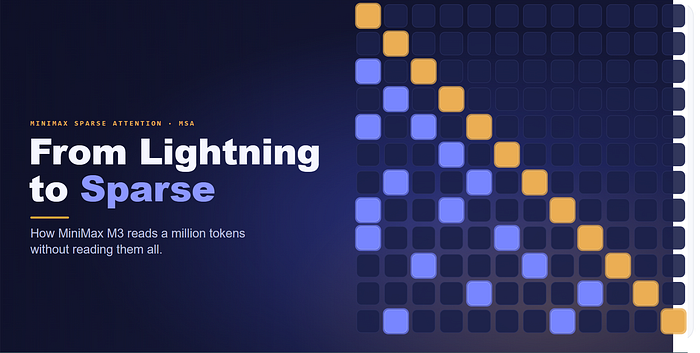
After the intro, the article explains why standard (softmax) attention becomes prohibitively expensive at long context lengths due to quadratic growth in attention compute, then contrasts two general approaches to cheaper attention: replacing it with linear/state-space style methods versus keeping softmax but computing it sparsely over selected subsets of the past. It walks through how MiniMax Sparse Attention (MSA) works in practice: a tiny “index” step selects relevant contiguous blocks (not individual tokens), then exact attention runs only over those chosen blocks, while the most recent block is always retained. The piece emphasizes that MSA is not merely an approximate attention hack; instead, sparsity is trained in from the start using a KL-loss-style alignment so the indexer learns to predict where the full attention would look, with gradient detachment preventing feedback loops. It further addresses a key systems reality—fewer FLOPs don’t guarantee faster wall-clock performance—so the work includes GPU-aware co-design such as exp-free top-k selection and reorganizing computation to preserve dense, efficient kernels. Finally, it summarizes results (large attention savings with quality matching), places MSA in the broader long-context ecosystem, and closes with takeaways and open questions about precision tradeoffs and the need for careful evaluation beyond benchmark wins.
Read the full blog for free on Medium.
Join thousands of data leaders on the AI newsletter. Join over 80,000 subscribers and keep up to date with the latest developments in AI. From research to projects and ideas. If you are building an AI startup, an AI-related product, or a service, we invite you to consider becoming a sponsor.
Published via Towards AI
Towards AI Academy
We Build Enterprise-Grade AI. We'll Teach You to Master It Too.
15 engineers. 100,000+ students. Towards AI Academy teaches what actually survives production.
Start free — no commitment:
→ 6-Day Agentic AI Engineering Email Guide — one practical lesson per day
→ Agents Architecture Cheatsheet — 3 years of architecture decisions in 6 pages
Our courses:
→ AI Engineering Certification — 90+ lessons from project selection to deployed product. The most comprehensive practical LLM course out there.
→ Agent Engineering Course — Hands on with production agent architectures, memory, routing, and eval frameworks — built from real enterprise engagements.
→ AI for Work — Understand, evaluate, and apply AI for complex work tasks.
Note: Article content contains the views of the contributing authors and not Towards AI.
Related posts
Recent Posts