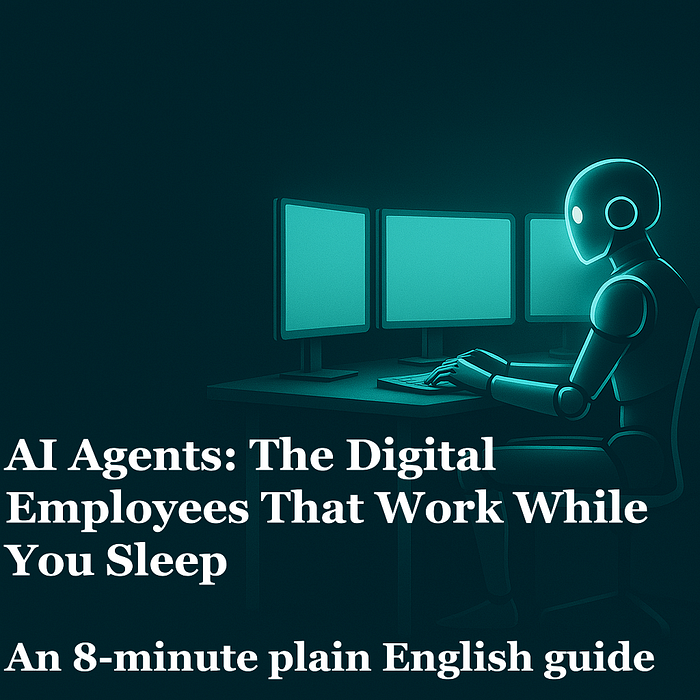
AI Agents: The Digital Employees That Work While You Sleep
Last Updated on June 8, 2026 by Editorial Team
Author(s): Maduri Kolanu
Originally published on Towards AI.
AI Agents: The Digital Employees That Work While You Sleep
Everyone’s talking about AI Agents. Here’s what they actually are, why they matter — and why you’ll use one before the end of this year.

If you’ve been following any tech news lately, you’ve probably heard the phrase “AI Agent” thrown around constantly. It sounds futuristic — maybe even a little scary. But I promise you, by the end of this article, you’ll understand exactly what it means, how it works, and why it’s actually one of the most exciting things happening in tech right now.
No computer science degree required. Let’s go.
First, What Is an AI Agent? Let’s Use a Real-World Example.
Imagine you’re a busy manager and you hire a new assistant. On Day 1, you tell them: “Book me a flight to Delhi, find a hotel near the venue, and send me the confirmation.”
A regular assistant (or the old way of using AI) would do one thing at a time. They’d Google flights, then stop and ask you — “Which flight do you want?” Then search for hotels, ask again — “Which hotel?” It’s slow. It’s back-and-forth. It depends on you being there the whole time.
Now imagine a super-assistant who takes that one instruction and runs with it. They search for flights, compare prices, pick the best one based on what they know you prefer, book the hotel, add everything to your calendar, and send you a neat summary — all without you lifting a finger.
“That super-assistant? That’s an AI Agent.”
An AI Agent is an AI that can take actions, make decisions, and complete multi-step tasks — all on its own — based on one goal you give it.
Old AI vs. AI Agents — What’s the Difference?

Think of the old AI as a really smart encyclopedia — it gives you information. An AI Agent is more like a smart contractor — it gets things done.
How Does an AI Agent Actually Work?

Here’s the simple version. When you give an AI Agent a task, it does four things in a loop:
- Think: It breaks the big goal into smaller steps. (Like a chef reading a recipe before starting to cook.)
- Act: It uses tools — search the web, write code, send an email, read a document. (Like a chef picking up the knife and starting to chop.)
- Observe: It checks what happened. Did that work? Did something go wrong? (Like the chef tasting the sauce.)
- Adjust: Based on what it found, it tries again or moves to the next step. (Like the chef adding more salt.)
This loop — Think, Act, Observe, Adjust — is called the ReAct loop in AI research. But forget the jargon. Just think of it as how any smart person solves a complex problem.
A Real-World Example: Hiring an AI Agent for Your Business
Let’s say you run a small business and you want to know what your competitors are doing. Here’s what would happen in two worlds:

That’s not science fiction. This is happening right now in 2026. Tools like Claude, Operator-style agents, and auto-GPT systems are doing exactly this for thousands of businesses every single day.
Where Are AI Agents Showing Up in Real Life?
You might be using one without even realizing it. Here are some everyday examples:
Customer Support: When you chat with a company’s support bot and it actually resolves your issue — checks your order, processes a refund, sends you a new tracking link — that’s an AI Agent. It didn’t just give you an FAQ answer. It did something.
Coding Assistants: Tools like GitHub Copilot or Claude Code don’t just write a line of code anymore. They read your entire codebase, spot bugs, fix them, write tests, and even open a pull request. That’s an AI Agent working for your developer team.
Healthcare: AI Agents are scanning patient records, flagging early warning signs, and suggesting follow-up appointments — not as a recommendation to a doctor, but as an automated action in the workflow.
Personal Finance: Imagine an AI that monitors your spending, notices you’re about to go over budget, moves money between accounts, and sends you a daily digest. Not hypothetical — some fintech apps are rolling this out now.
The “Intern” Analogy That Makes This Crystal Clear
Think of an AI Agent as the world’s most hardworking, never-sleeping intern — who never gets tired, never gets bored, and never forgets a task.”
An intern, when given a project, goes off, researches it, does the work, runs into problems, figures them out, and comes back with a result. You don’t stand over them micromanaging every step. You set the goal, check the output, and give feedback.
AI Agents work the same way. You set the goal. They run. You review the output. This is a fundamentally different relationship than just asking AI a question.
Should You Be Worried?
This is the question everyone asks, and it deserves an honest answer.
Yes, there are legitimate concerns. When an AI Agent has the ability to take real actions — send emails, make purchases, modify files — mistakes can have real consequences. A misunderstood instruction could mean the wrong email gets sent to the wrong person. Or a script runs that shouldn’t.
This is why the best AI Agent systems in 2026 are built with what’s called human-in-the-loop design. For anything critical, the Agent pauses and says: “I’m about to do X. Should I proceed?” You stay in control. You set the guardrails.
Think of it like giving your intern a company credit card — but capped at ₹500. They can get things done. They can’t accidentally ruin you.
What This Means for You — Whether You’re a Student, Developer, or Business Owner
The biggest shift AI Agents bring isn’t about technology. It’s about how you think about delegation.
Until now, you could only delegate tasks to other humans. AI Agents mean you can now delegate to software — not just simple tasks like “send this email at 9am,” but complex, judgment-based tasks like “research this topic and come back with a recommendation.”
If you’re a student, you can use an agent to research papers, summarize textbooks, and organize your notes — giving you more time to think and create.
If you’re a developer, agents can handle repetitive tasks, write boilerplate code, and even manage deployments.
If you’re a business owner, an AI Agent can handle customer queries, track inventory changes, and report anomalies — without a full-time hire.
Maduri Kolanu · Senior Technical Lead · Making complex AI concepts simple for everyone to understand.
Join thousands of data leaders on the AI newsletter. Join over 80,000 subscribers and keep up to date with the latest developments in AI. From research to projects and ideas. If you are building an AI startup, an AI-related product, or a service, we invite you to consider becoming a sponsor.
Published via Towards AI
Towards AI Academy
We Build Enterprise-Grade AI. We'll Teach You to Master It Too.
15 engineers. 100,000+ students. Towards AI Academy teaches what actually survives production.
Start free — no commitment:
→ 6-Day Agentic AI Engineering Email Guide — one practical lesson per day
→ Agents Architecture Cheatsheet — 3 years of architecture decisions in 6 pages
Our courses:
→ AI Engineering Certification — 90+ lessons from project selection to deployed product. The most comprehensive practical LLM course out there.
→ Agent Engineering Course — Hands on with production agent architectures, memory, routing, and eval frameworks — built from real enterprise engagements.
→ AI for Work — Understand, evaluate, and apply AI for complex work tasks.
Note: Article content contains the views of the contributing authors and not Towards AI.
Related posts
Recent Posts