How LLM Quantization Works: INT8, INT4, GPTQ, and AWQ Explained
Last Updated on June 14, 2026 by Editorial Team
Author(s): The Dev Loop
Originally published on Towards AI.
A plain-language guide to reducing model precision: the mechanism, the accuracy trade-off, and how to choose a method.
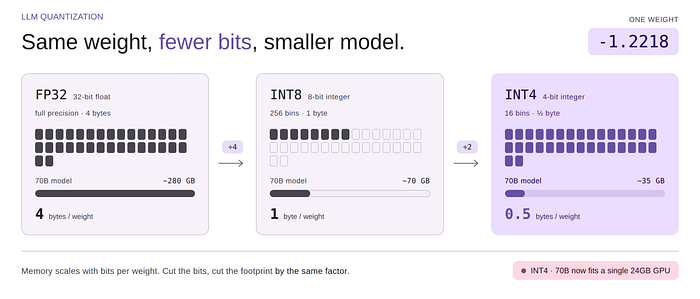
You found the perfect open-weights model. You read the benchmarks, you cloned the repo, and then you hit the wall every engineer hits eventually. A 70-billion-parameter model in standard FP16 precision needs roughly 140GB of memory just to load, far more than what fits on a consumer GPU.
After the opening, the article explains that quantization reduces memory by shrinking the number of bits used to store each model weight (e.g., FP32/FP16 to INT8/INT4), making the model small enough to run on limited hardware. It walks through the underlying mechanics step by step—finding a weight range, computing a scale, rounding weights into integer “bins,” and then dequantizing during inference—highlighting that quantization error is permanent and comes from the rounding step. It then quantifies the “what you save” side with memory math and notes that INT8 is often a near-safe, low-quality-drop option, while lower bit widths face two key failure modes: outliers that force the scale to cover extreme values (crushing smaller weights) and a non-linear “precision cliff” where quality can suddenly fall below a threshold. To address these issues, it surveys post-training methods like GPTQ (layer-wise, error-minimizing quantization), AWQ (activation-aware protection of important weights for strong INT4 quality), and GGUF (a local-friendly hybrid format that can split compute across CPU/GPU and offers multiple quantization levels). Finally, it provides a practical decision rule: start with INT8 for production on GPUs, choose AWQ/INT4 for tight VRAM budgets on NVIDIA hardware, use GGUF for local runs, and—most importantly—do not assume quality below 4-bit; instead, measure with an evaluation set because the cliff point is model-dependent.
Read the full blog for free on Medium.
Join thousands of data leaders on the AI newsletter. Join over 80,000 subscribers and keep up to date with the latest developments in AI. From research to projects and ideas. If you are building an AI startup, an AI-related product, or a service, we invite you to consider becoming a sponsor.
Published via Towards AI
Towards AI Academy
We Build Enterprise-Grade AI. We'll Teach You to Master It Too.
15 engineers. 100,000+ students. Towards AI Academy teaches what actually survives production.
Start free — no commitment:
→ 6-Day Agentic AI Engineering Email Guide — one practical lesson per day
→ Agents Architecture Cheatsheet — 3 years of architecture decisions in 6 pages
Our courses:
→ AI Engineering Certification — 90+ lessons from project selection to deployed product. The most comprehensive practical LLM course out there.
→ Agent Engineering Course — Hands on with production agent architectures, memory, routing, and eval frameworks — built from real enterprise engagements.
→ AI for Work — Understand, evaluate, and apply AI for complex work tasks.
Note: Article content contains the views of the contributing authors and not Towards AI.
Related posts
Recent Posts