The Algorithm That’s Dumb by Name but Smart by Nature: Naive Bayes
Last Updated on June 18, 2026 by Editorial Team
Author(s): Sai Bhargav Rallapalli
Originally published on Towards AI.
A no-nonsense guide to understanding one of the most battle-tested ML algorithms out there
I’ll be honest with you — when I first heard “Naive Bayes,” I thought, how good can an algorithm be if it calls itself naive?
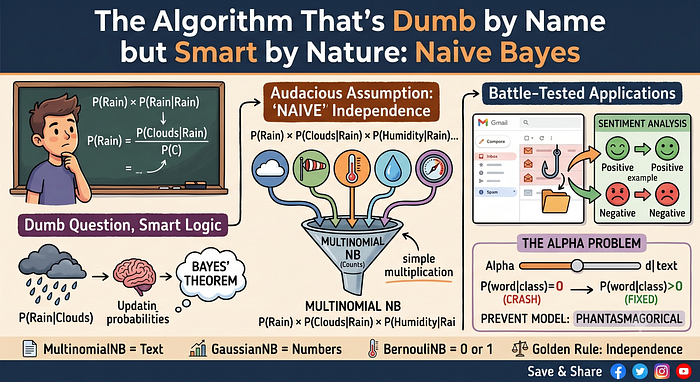
After the intro, the article walks through Bayes’ Theorem using the “dark clouds → rain” example, then explains what makes Naive Bayes “naive” via the assumption of conditional independence among features (given the class) and how that simplifies the math into a product of probabilities. It covers priors (class starting probabilities), demonstrates the “alpha problem” with unseen words causing zero-probability collapse, and shows how Laplace/“alpha” smoothing fixes this with a tunable uncertainty knob. The piece then distinguishes sklearn’s Naive Bayes variants (GaussianNB, MultinomialNB, BernoulliNB) and argues that MultinomialNB is typically the right fit for text using word counts/frequencies. It ties everything together into a training-and-prediction pipeline, highlights the main gotchas (independence and equal feature importance), and provides guidance on when to use Naive Bayes versus when to avoid it (e.g., correlated features, needing calibrated probabilities). Finally, it ends with a quick reference on Naive Bayes + boosting/bagging concepts and “golden rules” to remember.
Read the full blog for free on Medium.
Join thousands of data leaders on the AI newsletter. Join over 80,000 subscribers and keep up to date with the latest developments in AI. From research to projects and ideas. If you are building an AI startup, an AI-related product, or a service, we invite you to consider becoming a sponsor.
Published via Towards AI
Towards AI Academy
We Build Enterprise-Grade AI. We'll Teach You to Master It Too.
15 engineers. 100,000+ students. Towards AI Academy teaches what actually survives production.
Start free — no commitment:
→ 6-Day Agentic AI Engineering Email Guide — one practical lesson per day
→ Agents Architecture Cheatsheet — 3 years of architecture decisions in 6 pages
Our courses:
→ AI Engineering Certification — 90+ lessons from project selection to deployed product. The most comprehensive practical LLM course out there.
→ Agent Engineering Course — Hands on with production agent architectures, memory, routing, and eval frameworks — built from real enterprise engagements.
→ AI for Work — Understand, evaluate, and apply AI for complex work tasks.
Note: Article content contains the views of the contributing authors and not Towards AI.
Related posts
Recent Posts