Top 20 Bayesian Regression Interview Questions and Answers (Part 2 of 2)
Last Updated on June 25, 2026 by Editorial Team
Author(s): Shahidullah Kawsar
Originally published on Towards AI.
Machine Learning Interview Preparation Part 41
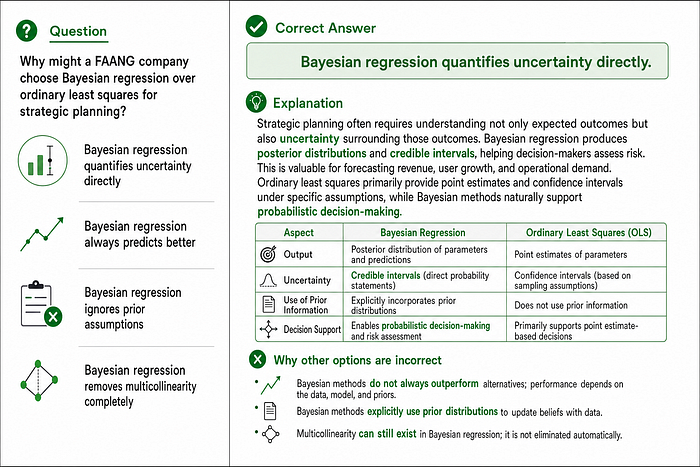
Checkout the infographics! Read this blog free.
The article continues as a quiz covering additional Bayesian regression concepts and interpretation, including when Bayesian methods are preferable to ordinary least squares, how to interpret posterior probabilities from experiments, why hierarchical Bayesian regression helps with sparse data, and how Bayesian sequential updating supports continuously arriving recommendations. It also explains how to read posterior predictive intervals and credible intervals, the effect of prior variance as regularization, comparing models with different posterior variances, diagnosing sensitivity to priors, and interpreting credible intervals probabilistically. The final parts focus on using predictive distributions for long-term forecasting by capturing uncertainty, and they include option-by-option reasoning for correct answers across the questions.
Read the full blog for free on Medium.
Join thousands of data leaders on the AI newsletter. Join over 80,000 subscribers and keep up to date with the latest developments in AI. From research to projects and ideas. If you are building an AI startup, an AI-related product, or a service, we invite you to consider becoming a sponsor.
Published via Towards AI
Towards AI Academy
We Build Enterprise-Grade AI. We'll Teach You to Master It Too.
15 engineers. 100,000+ students. Towards AI Academy teaches what actually survives production.
Start free — no commitment:
→ 6-Day Agentic AI Engineering Email Guide — one practical lesson per day
→ Agents Architecture Cheatsheet — 3 years of architecture decisions in 6 pages
Our courses:
→ AI Engineering Certification — 90+ lessons from project selection to deployed product. The most comprehensive practical LLM course out there.
→ Agent Engineering Course — Hands on with production agent architectures, memory, routing, and eval frameworks — built from real enterprise engagements.
→ AI for Work — Understand, evaluate, and apply AI for complex work tasks.
Note: Article content contains the views of the contributing authors and not Towards AI.
Related posts
Recent Posts