AI Ethics & Quality Control— Prompt to Profit · Day 27 of 30
Last Updated on July 6, 2026 by Editorial Team
Author(s): Faheem Munshi
Originally published on Towards AI.
AI Ethics & Quality Control— Prompt to Profit · Day 27 of 30
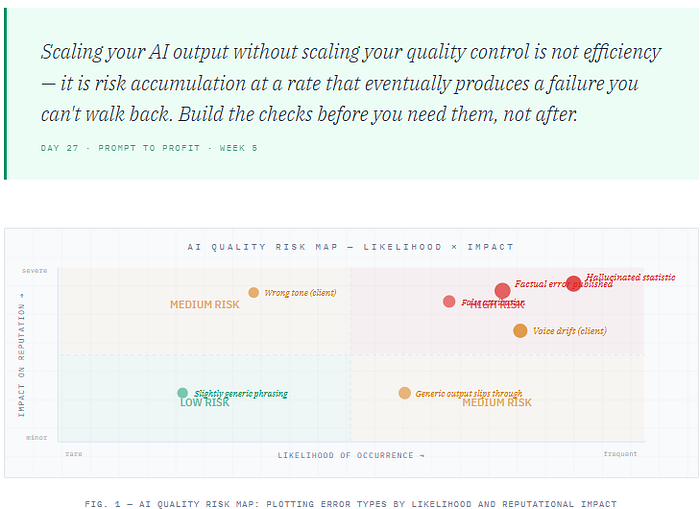
Scaling your output without scaling your standards is not growth — it is risk accumulation. Here is the quality control system that keeps your AI operation honest.
Quality is not a feature of a single output. It is a property of a system — the consistent, reliable tendency to produce work that meets a defined standard regardless of volume, velocity, or the conditions under which the work was produced. A writer who occasionally produces brilliant pieces is talented. A writer who consistently produces good pieces, across hundreds of engagements and under varying circumstances, has a quality system. The distinction matters enormously when you start to scale.
When your AI operation was small — a few prompts, occasional use, manual review of every output — quality was maintained by proximity. You read everything. You caught the errors. You corrected the drift. As scale increases, this proximity disappears. You are no longer reviewing everything. The volume is too high. The question shifts from “did I check this?” to “does my system catch what I would have caught?”
This is the quality control problem, and it has an ethical dimension as well as a practical one. AI errors don’t just waste time — they can misinform readers, misrepresent clients, produce content that is factually wrong at scale, or generate outputs that subtly misrepresent your positions and values. At low volume, these risks are manageable manually. At scale, only a system can manage them.

The Three Ethical Obligations of an AI Practitioner
Ethics in AI use is not primarily a philosophical question. It is a practical one — a set of concrete obligations that determine whether your AI-assisted work is trustworthy, and by extension, whether your professional reputation remains intact as the volume of AI-assisted work increases.
There are three obligations. They are not complex. But they require being named explicitly, because the implicit assumption in much AI use is that “AI-assisted” is equivalent to “acceptable” without further scrutiny. It is not.

The Quality Control Checklist
A checklist is the most reliable quality control tool in any high-volume domain. Aviation, surgery, nuclear operations — every field where errors have catastrophic consequences uses checklists not because practitioners are incompetent, but because checklists are more reliable than memory under production pressure. The following QC checklist applies to any significant AI output before it is published, sent, or used in a client context.

The Quality Assurance Prompt
The checklist above is a human review tool. The prompt below is its AI-powered counterpart — a structured quality review prompt that you run on significant outputs before publishing, sending, or delivering them. It is not a replacement for the human checklist. It is a first pass that surfaces obvious issues, so your human review can focus on the subtler ones.


Quality States — Pass, Watch, and Fail
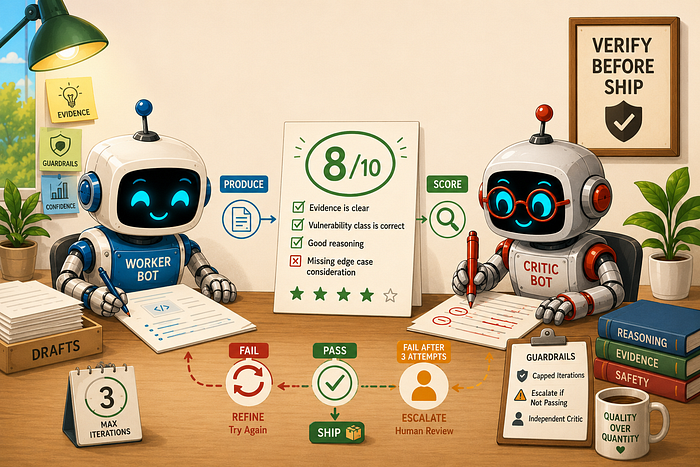
Not all quality issues are equal. A useful QC system distinguishes between outputs that pass review, outputs that require watching or iteration, and outputs that should never be published or sent. The three status states below define what each means in practice:


The Monthly Quality Audit
The three-layer QC system above operates at the individual output level — review before publishing. The Monthly Quality Audit operates at the system level — review of whether the system itself is maintaining standards over time. It takes 30 minutes and catches drift that output-level review misses because it appears gradual rather than in any single piece.
The audit protocol is simple: pull ten random pieces of AI-assisted output from the previous month. Read them as a set, not as individual pieces. What patterns do you notice? Where has quality held? Where has it slipped? Is there a format, topic, or platform where the output is consistently weaker? Is there a prompt in your library that is producing reliably poor results? These patterns are invisible at the individual output level and visible at the portfolio level.

The quality gauge in this article’s header does not point to “excellent” by default. It oscillates. That is the correct model of how quality works in any complex system — not a fixed state, but a monitored tendency that requires active calibration to maintain. The needle drifts. The job of a quality control system is to notice the drift before the audience does, and to make the correction before the drift becomes the new baseline.
Your AI operation will produce errors. The question is not whether you can prevent all of them — you cannot. The question is whether your system catches them before they cause harm, and whether it learns from them so they are less likely to recur. That is what a quality control system does. Build it with the same care you built everything else in this series, and it will protect everything else you’ve built.
Tomorrow, Day 28, we move to the 90-Day AI Roadmap — a structured, sequenced implementation plan for everything covered in this series, taking you from where you are now to a fully operational AI-powered practice within three months.

For more resources and documents, please refer to the links in my profile page: Faheem Munshi — Medium
Join thousands of data leaders on the AI newsletter. Join over 80,000 subscribers and keep up to date with the latest developments in AI. From research to projects and ideas. If you are building an AI startup, an AI-related product, or a service, we invite you to consider becoming a sponsor.
Published via Towards AI
Towards AI Academy
We Build Enterprise-Grade AI. We'll Teach You to Master It Too.
15 engineers. 100,000+ students. Towards AI Academy teaches what actually survives production.
Start free — no commitment:
→ 6-Day Agentic AI Engineering Email Guide — one practical lesson per day
→ Agents Architecture Cheatsheet — 3 years of architecture decisions in 6 pages
Our courses:
→ AI Engineering Certification — 90+ lessons from project selection to deployed product. The most comprehensive practical LLM course out there.
→ Agent Engineering Course — Hands on with production agent architectures, memory, routing, and eval frameworks — built from real enterprise engagements.
→ AI for Work — Understand, evaluate, and apply AI for complex work tasks.
Note: Article content contains the views of the contributing authors and not Towards AI.
Related posts
Recent Posts