I Built the Same App with Fable 5, Opus 4.8, and Sonnet 5…The Results Weren’t Even Close
Last Updated on July 15, 2026 by Editorial Team
Author(s): Felix Kebaya
Originally published on Towards AI.
I Built the Same App with Fable 5, Opus 4.8, and Sonnet 5…The Results Weren’t Even Close
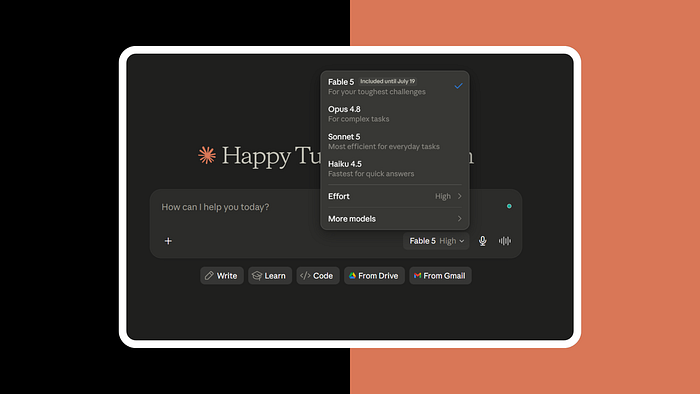
Anthropic now has three models that can code:
The author describes testing three Claude coding models (Fable 5, Opus 4.8, and Sonnet 5) by pasting the same real-world expense tracker spec into each one and using the same stack, features, and judgment criteria. Fable 5 completed the full production-ready app in a single prompt, with all five features working after the first pass. Opus 4.8 produced most features quickly but required an extra follow-up prompt to fix a CSV export/filtering bug. Sonnet 5 needed multiple prompts because it initially missed connections like the category filter to Supabase, then required further corrections for CSV headers, date formatting, and ultimately mobile responsiveness. The article compares prompt counts, timing, and downstream cost implications for teams, then ends with the author’s updated routing strategy: use Fable 5 for complex multi-table specs, Opus 4.8 for mid-tier tasks as a balance, and Sonnet 5 for simpler/quick features—emphasizing that the best model depends on task complexity rather than choosing a single “best” model.
Read the full blog for free on Medium.
Join thousands of data leaders on the AI newsletter. Join over 80,000 subscribers and keep up to date with the latest developments in AI. From research to projects and ideas. If you are building an AI startup, an AI-related product, or a service, we invite you to consider becoming a sponsor.
Published via Towards AI
Towards AI Academy
We Build Enterprise-Grade AI. We'll Teach You to Master It Too.
15 engineers. 100,000+ students. Towards AI Academy teaches what actually survives production.
Start free — no commitment:
→ 6-Day Agentic AI Engineering Email Guide — one practical lesson per day
→ Agents Architecture Cheatsheet — 3 years of architecture decisions in 6 pages
Our courses:
→ AI Engineering Certification — 90+ lessons from project selection to deployed product. The most comprehensive practical LLM course out there.
→ Agent Engineering Course — Hands on with production agent architectures, memory, routing, and eval frameworks — built from real enterprise engagements.
→ AI for Work — Understand, evaluate, and apply AI for complex work tasks.
Note: Article content contains the views of the contributing authors and not Towards AI.
Recent Posts

![Best Object Detection Models for Computer Vision [2026 Updated]](https://miro.medium.com/v2/resize:fit:700/1*J_SSY8rhe8jzEmEriNMumA.gif "Best Object Detection Models for Computer Vision [2026 Updated]")