When AI and RWE Converge: Accelerating Evidence for Rare Disease and Innovative Therapies
Author(s): MadeAi
Originally published on Towards AI.
When AI and RWE Converge: Accelerating Evidence for Rare Disease and Innovative Therapies
Why Evidence for Rare Disease Matters
AI and real-world evidence (RWE) are reshaping the path from laboratory discovery to regulatory approval. Their convergence matters most for patients who can’t afford to wait. For patients with rare diseases, waiting for treatment can mean years of uncertainty. In the United States, a rare disease is generally defined as one affecting fewer than 200,000 people. The medical innovation system wasn’t designed for them. Traditional clinical trials require large cohorts, months of enrollment, and statistical power that rare diseases simply don’t have. Moreover, regulatory bodies like the FDA demand rigorous evidence before approval, yet the very rarity that defines these conditions makes that evidence exceptionally difficult to gather.
This is the paradox: patients with the greatest need often experience the longest wait. Meanwhile, clinicians treating these patients generate insights daily from their real-world observations that remain siloed in electronic health records (EHRs), wasted in isolation.
Enter the convergence of two powerful forces: real-world evidence and an AI platform for life sciences . When combined strategically, they dissolve bottlenecks that have plagued medical innovation for decades. Consequently, we’re witnessing a seismic shift in how ev idence is generated, validated, and deployed.
Key Insight: Traditional clinical trials are designed primarily for large, relatively uniform patient populations. Combining AI with RWE can help rare disease researchers generate evidence faster while maintaining scientific rigor.
Building Blocks: RWE and AI in Evidence for Rare Disease
Before exploring their convergence, let’s clarify each component. RWE refers to data collected outside the controlled environment of randomized controlled trials. These include patient registries, electronic health records, wearable devices, and insurance claims. RWE captures how treatments perform in actual practice, among diverse populations, including comorbidities and concurrent medications that clinical trials exclude. Transitioning from controlled trials to real-world settings introduces complexity, but also richness.
Separately, each has limitations. RWE alone can confound causation with correlation; a patient who improved might have done so due to underlying disease trajectory, not the drug. AI alone, trained on historical data, inherits its biases and can hallucinate patterns. But together, they form a self-correcting system.
How the AI and RWE Convergence Works

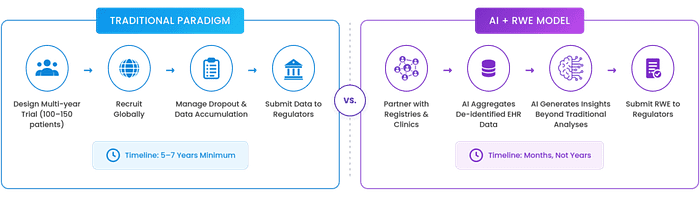
Imagine a biotech company has developed a novel therapy for a rare neurodegenerative disorder. Under a traditional approach, the company may conduct a multi-year study involving 100 to 150 patients. It must recruit participants across several locations, manage patient dropout, collect endpoint data, and prepare the regulatory submission.
Under the AI + RWE model, the process unfolds differently. First, the company partners with patient registries, academic medical centers, and specialty clinics already treating this rare disease. Within months and not years, AI systems aggregate de-identified EHR data from thousands of patients with the condition. AI algorithms then perform tasks that were previously impossible:
- Cohort definition: AI identifies the exact phenotype of patients most likely to benefit, going beyond simple diagnostic codes.
- Baseline adjustment: Machine learning models account for confounders-disease severity, prior treatments, genetic factors in real time.
- Pattern detection: AI spots subgroups responding differently to therapy, enabling precision medicine insights.
- Safety synthesis: NLP mines clinical notes for adverse events that standard databases miss, creating an early warning system.
Regulatory bodies such as the FDA, EMA, and others increasingly recognize this hybrid evidence pathway. In fact, the FDA’s Real-World Data (RWD) Program now formally accepts well-designed RWE studies as supporting evidence for approval. The bottleneck is incrementally dissolving.
From Concept to Implementation: The Role of Intelligent Data Integration
Effective implementation happens at the intersection of data engineering and machine learning. Modern platforms synthesize RWE at scale by:
- Harmonizing data across disparate sources (different EHR vendors, registries, claims databases) into a unified semantic model.
- Applying NLP to extract clinical phenotypes, treatments, and outcomes from unstructured narrative data.
- Implementing machine learning models to identify patient cohorts, predict treatment response, and detect signals.
- Ensuring compliance with HIPAA, GDPR, and other privacy frameworks through de-identification and federated learning approaches.
What emerges is a form of evidence that is both faster to generate and more clinically relevant because it reflects diverse real populations. Additionally, regulatory timelines compress from years to months, accelerating patient access.
Traditional vs. AI-Assisted Evidence Generation

The comparison reveals why the convergence is so transformative. For rare diseases, where trial recruitment is already a nightmare, RWE dramatically reduces friction. For innovative therapies, the first-mover advantage can mean market dominance, and AI accelerates time-to-insight. Together, they compress timelines without sacrificing rigor.
Real-World Implications: Who Wins?
The beneficiaries extend across the entire ecosystem. Patients with rare diseases gain faster access to treatments that work. Clinicians benefit from AI-derived insights, including subgroup analyses, biomarker associations, and safety signals, which in turn improve treatment selection and patient outcomes. Regulatory bodies receive evidence that better reflects clinical reality, enabling more informed decisions. Pharmaceutical companies reduce trial costs, compress development timelines, and differentiate competitive products through real-world evidence packages.
Consider a recent example, hereditary angioedema (HAE), a rare genetic condition. Traditional drug development for HAE faced recruitment hurdles; the condition affects roughly 1 in 50,000 people, and symptomatic patients are geographically dispersed. However, leveraging patient registries, EHR data from specialty centers, and AI-driven cohort identification, researchers synthesized evidence far faster than historical trials would allow. The result: accelerated regulatory pathways and earlier patient access.
Implementation Considerations and Challenges
The promise of combining AI with RWE is undeniable. But transforming that promise into reliable, regulatory-grade insights takes more than sophisticated algorithms. Success depends on building a strong foundation across data, governance, compliance, and scientific rigor.

Data Quality Comes First
RWE is inherently complex. Data arrives from multiple sources with different coding standards, formats, and levels of completeness. Missing values, inconsistent terminology, and documentation errors can quickly compromise AI-driven analysis. Before meaningful insights can be generated, organizations must invest in robust data engineering, harmonization, and validation frameworks that ensure the data is accurate, consistent, and fit for purpose.
Representative Data Drives Better Decisions
AI models are only as representative as the data they learn from. When RWE is dominated by data from large academic medical centers, it may overlook patients from rural, community, or underserved healthcare settings. Expanding data sources to capture diverse patient populations helps reduce bias, improve generalizability, and produce evidence that better reflects real-world clinical practice.
Regulatory Alignment is Essential
Regulatory agencies, including the FDA, continue to encourage the use of RWE, but expectations around study design, statistical methods, and documentation are still evolving. Organizations should engage regulators early in the evidence-generation process, such as through Type B meetings, to align on study objectives, methodologies, and evidence standards. Early collaboration helps minimize uncertainty and strengthens the credibility of the final submission.
Privacy Must Be Built into Every Workflow
Protecting patient data remains a fundamental requirement for any AI-driven RWE initiative. Secure data governance, effective de-identification, and regulatory compliance must be embedded throughout the workflow. Emerging approaches such as federated learning provide an effective path forward by allowing AI models to learn from distributed datasets without moving or centralizing sensitive patient information, helping organizations balance innovation with privacy and compliance.
The Future: AI + RWE as Standard Practice
We are at an inflection point. Within 5 years, AI-synthesized RWE will be standard for supporting regulatory submissions-not exceptional. The FDA’s 21st Century Cures Act and successor frameworks actively encourage this shift. Moreover, as electronic health records mature and data interoperability improves, RWE generation will become routine hygiene.
For rare diseases, this trend is uniquely powerful. Conditions that were once deemed ‘too rare’ for efficient trial design will become tractable research subjects. Patients will access life-changing therapies years earlier. The system will self-correct: as more data accumulates, AI insights sharpen, and evidence strengthens continuously rather than at discrete trial endpoints.
Conclusion: The Convergence is Inevitable
The fusion of AI and RWE isn’t just a tech trend; it’s a lifeline for patients with rare diseases and a catalyst for innovative therapies. By embracing this convergence thoughtfully, we can generate stronger evidence faster and more equitably. The future of medicine looks brighter when data meets intelligence in the real world.
Organizations that master this convergence are integrating RWE sources, deploying AI thoughtfully, and engaging regulators transparently. It will unlock evidence faster, serve patients sooner, and build competitive moats. Those that cling to 20th-century trial paradigms will fall behind.
For patients with hereditary angioedema, spinal muscular atrophy, or the thousands of other rare conditions, this convergence promises something previously unthinkable: treatments that reach them, not in decades, but in years. And in rare disease, every year saved is a life changed.

Originally published at https://madeai.com on July 15, 2026.
Join thousands of data leaders on the AI newsletter. Join over 80,000 subscribers and keep up to date with the latest developments in AI. From research to projects and ideas. If you are building an AI startup, an AI-related product, or a service, we invite you to consider becoming a sponsor.
Published via Towards AI
Towards AI Academy
We Build Enterprise-Grade AI. We'll Teach You to Master It Too.
15 engineers. 100,000+ students. Towards AI Academy teaches what actually survives production.
Start free — no commitment:
→ 6-Day Agentic AI Engineering Email Guide — one practical lesson per day
→ Agents Architecture Cheatsheet — 3 years of architecture decisions in 6 pages
Our courses:
→ AI Engineering Certification — 90+ lessons from project selection to deployed product. The most comprehensive practical LLM course out there.
→ Agent Engineering Course — Hands on with production agent architectures, memory, routing, and eval frameworks — built from real enterprise engagements.
→ AI for Work — Understand, evaluate, and apply AI for complex work tasks.
Note: Article content contains the views of the contributing authors and not Towards AI.
Related posts
Recent Posts