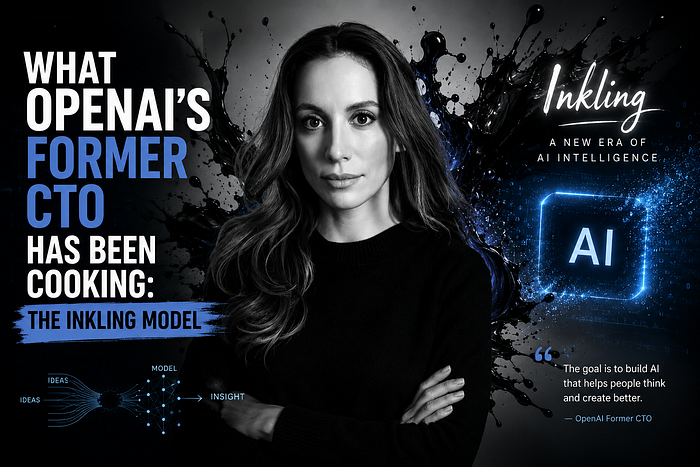
The Inkling Model: What OpenAI’s Former CTO Has Been Cooking
Last Updated on July 23, 2026 by Editorial Team
Author(s): allglenn
Originally published on Towards AI.
Mira Murati’s Thinking Machines Lab just shipped its first model, and led with the line “this is not the strongest model available.” Here’s what Inkling actually is, and why that admission is the interesting part.
Mira Murati spent six years as OpenAI’s CTO, and for one strange weekend in November 2023 she was its interim CEO, appointed by the board the night it fired Sam Altman, then present in the room five days later when the board reinstated him instead. She left the company in September 2024, raised roughly $2 billion in seed funding for a new startup called Thinking Machines Lab, and reportedly hit a $12 billion valuation before shipping a single product.
The article explains that Thinking Machines’ Inkling release is designed less around claiming leaderboard dominance and more around a self-improving fine-tuning loop: the model is made to “fine-tune itself” in a harness where it generates its own training plan, evaluation data, and post-training weights to meet a task target (like producing outputs that never use the letter “e”). It then details Inkling’s technical profile—an MoE transformer with huge parameter counts and a very long context window—along with architectural departures intended for long-context efficiency. The author summarizes training and emergent behaviors from large-scale reinforcement learning, including terser internal reasoning under pressure and an effort parameter that lets developers trade reasoning depth for cost and latency. Benchmarks show a mixed competitive picture, with Inkling standing out especially in native audio/vision handling and cost curves rather than a single top score. The piece also covers “epistemics” (calibration and claimed resistance to censorship), safety results on refusal benchmarks, and a business model where weights are free but customization tooling (via Tinker) drives revenue, concluding that the “not the strongest” positioning signals a broader industry argument: raw frontier capability is becoming commoditized, while meaningful differentiation will come from customization and integration.
Read the full blog for free on Medium.
Join thousands of data leaders on the AI newsletter. Join over 80,000 subscribers and keep up to date with the latest developments in AI. From research to projects and ideas. If you are building an AI startup, an AI-related product, or a service, we invite you to consider becoming a sponsor.
Published via Towards AI
Towards AI Academy
We Build Enterprise-Grade AI. We'll Teach You to Master It Too.
15 engineers. 100,000+ students. Towards AI Academy teaches what actually survives production.
Start free — no commitment:
→ 6-Day Agentic AI Engineering Email Guide — one practical lesson per day
→ Agents Architecture Cheatsheet — 3 years of architecture decisions in 6 pages
Our courses:
→ AI Engineering Certification — 90+ lessons from project selection to deployed product. The most comprehensive practical LLM course out there.
→ Agent Engineering Course — Hands on with production agent architectures, memory, routing, and eval frameworks — built from real enterprise engagements.
→ AI for Work — Understand, evaluate, and apply AI for complex work tasks.
Note: Article content contains the views of the contributing authors and not Towards AI.
Related posts
Recent Posts