Building Safe AI Agents for DevOps: Governance First, Automation Second
Last Updated on July 27, 2026 by Editorial Team
Author(s): Shrinidhi Atmakur
Originally published on Towards AI.
Building Safe AI Agents for DevOps: Governance First, Automation Second

Introduction
AI agents are rapidly becoming part of the modern DevOps toolkit. Imagine asking an AI assistant:
“Deploy Orders Service version 2.3.1 to staging.”
“Fetch logs for deployment job 1234.”
“Restart the payment service in the development cluster.”
“Show all failed deployments from the last 24 hours.”
Instead of navigating multiple dashboards, APIs, and command-line tools, engineers can interact with infrastructure using natural language.The productivity gains are impressive.
Building an agent that translates natural language into commands is easy.
However, there is a significant challenge. What happens when a user accidentally asks:
“Deploy version 5.0 directly to production.” OR “Delete the production namespace.”
If the AI agent has direct access to infrastructure, a simple prompt could cause a major outage. The reality is that building the AI component is often easier than building the governance, security, and control mechanisms. required to operate safely in enterprise environments.
The key principle is simple: A DevOps AI agent should be treated as a planner, not as an executor.
Giving AI Direct Control: The Biggest Mistake.
Many early AI agent implementations follow a dangerous pattern:
User Request -> LLM -> Shell Command -> Production Environment.
Example: User: “Deploy Orders Service”
AI generates: kubectl apply -f deployment.yaml
The command is then executed automatically.
This approach creates multiple risks: Prompt injection attacks, Accidental destructive actions, Unauthorized production changes, Lack of auditability, and compliance violations.
An AI model should never be trusted with unrestricted execution privileges.
A Safer Architecture
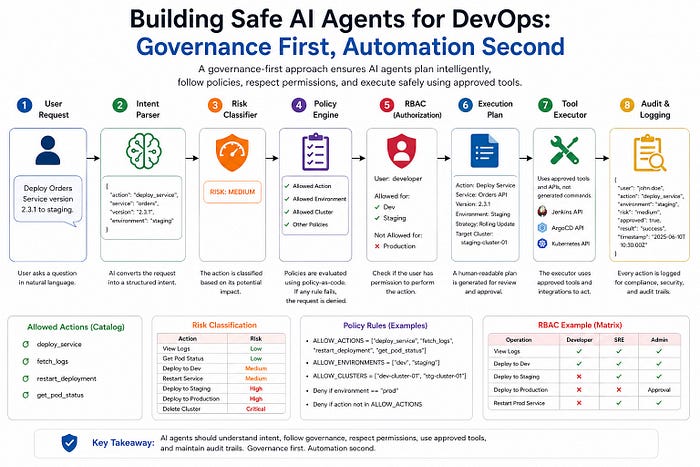
A safer architecture separates planning, governance, and execution. Here is the proposed approach.

In this model, the AI never interacts directly with infrastructur, i.e.,e Kubernetes, Jenkins, ArgoCD, Terraform, or cloud platforms.
Instead, it generates a structured action request.
Step 1: Convert Natural Language into Structured Actions
The AI’s first responsibility is intent extraction.
User request: “Deploy Orders Service version 2.3.1 to staging.”
AI output:
{
“action”: “deploy_service”,
“service”: “orders”,
“version”: “2.3.1”,
“environment”: “staging”
}
Notice that no shell commands, API calls, or infrastructure details are involved.The AI’s job is simply to understand the user’s intent.
Step 2: Maintain an Action Catalog
One of the most effective governance mechanisms is maintaining an explicit catalog of allowed actions.
For example:
ALLOWED_ACTIONS = [
“deploy_service”,
“fetch_logs”,
“restart_deployment”,
“get_pod_status”
]
If the AI produces:
{
“action”: “delete_cluster”
}
If that action does not exist in the catalog, the request is immediately rejected .This creates a boundary around what the agent can do.
Step 3: Classify Risk Before Execution
Not all actions carry the same level of risk. A simple risk classification layer can help determine whether an action should be automatically executed or blocked.
View logs -> Low
Get pod status -> Low
Deploy to development -> Medium
Deploy to production -> High
By classifying actions, organizations can introduce additional approval steps for sensitive operations.
Step 4: Enforce Policy Using Policy-as-Code
Policies should never be left to the discretion of the AI model.
Examples
ALLOW_ENVIRONMENTS = [
“dev”,
“staging”
]
Reject:
if environment == “prod”:
deny()
Allow:
if action == “fetch_logs”:
allow()
The AI does not decide whether something is allowed.The policy engine does.
Step 5: Generate an Execution Plan
Before execution, generate a human-readable plan.
Example:
Example Execution Plan
Action:Deploy Service
Service:Orders API
Version:2.3.1
Environment:Staging
Deployment Strategy:Rolling Update
Target Cluster:staging-cluster-01
This does two things: it makes the action transparent, and it gives a human a last chance to catch a mistake before it becomes an incident.
Step 6: Use Approved Tools, Not Generated Commands
One of the most important design principles is avoiding AI-generated shell commands.
Avoid:
command = llm_response
subprocess.run(command)
Instead, create approved tools.
DeployServiceTool()
FetchLogsTool()
RestartDeploymentTool()
The AI requests an action. The tool performs the action using predefined APIs.
jenkins_client.start_job(…)
This approach is significantly safer and more predictable.
Step 7: Implement Role-Based Access Control
The agent shouldn’t get its own authorization model — it should inherit the one your organization already trusts. Map every request to the requesting user’s existing roles and permissions, and enforce those same boundaries at the tool layer, not just in the chat UI. If a user can’t deploy to the staging environment through the dashboard, the agent shouldn’t be able to do it on their behalf either.
Step 8: Audit Everything
Every request should be logged.
Example:
{
 “user”: “john.doe”,
 “request”: “Deploy Orders Service”,
 “action”: “deploy_service”,
 “environment”: “staging”,
 “risk”: “medium”,
 “approved”: true,
 “result”: “success”
}
Audit logs provide:Compliance support, Incident investigations, Change tracking, Security reviews
If an action cannot be audited, it should not be automated.
Recommended Technology Stack
For teams building DevOps AI agents today:
Agent Framework : LangGraph, OpenAI SDK, Ollama
Governance: Custom governance, Open Policy Agent (OPA)
Authentication: existing enterprise authorization models ex: IBM App ID
Infrastructure Integration : Jenkins APIs, ArgoCD APIs, Kubernetes APIs and Terraform APIs
Storage: PostgreSQL, Cloudant
Code sample
Here is the sample AI code intent generation and gavernence check .
import json
import uuid
import requests
from datetime import datetime

OLLAMA_URL = "http://localhost:11434"
MODEL = "mistral"

# ------------------------------------------------------------------
# Governance Rules
# ------------------------------------------------------------------

ALLOWED_ACTIONS = [
 "deploy_service",
 "restart_deployment",
 "fetch_logs",
 "get_pod_status"
]

ALLOWED_ENVIRONMENTS = [
 "development",
 "staging"
]

ALLOWED_CLUSTERS = [
 "dev-cluster-01",
 "stg-cluster-01"
]


# ------------------------------------------------------------------
# Intent Extraction
# ------------------------------------------------------------------

def extract_intent(user_query, user_email, user_role):

 prompt = f"""
You are a DevOps Intent Extractor.

Convert the user request into JSON.

Allowed actions:
{', '.join(ALLOWED_ACTIONS)}

Return ONLY valid JSON.

Schema:

{{
 "action": "",
 "service": "",
 "environment": "",
 "cluster": ""
}}

Example:

User:
Deploy Orders Service version 2.3.1 to staging cluster stg-cluster-01

Output:
{{
 "action": "deploy_service",
 "service": "orders",
 "version": "2.3.1",
 "environment": "staging",
 "cluster": "stg-cluster-01"
}}

User:
{user_query}
"""

 response = requests.post(
 f"{OLLAMA_URL}/api/generate",
 json={
 "model": MODEL,
 "prompt": prompt,
 "format": "json",
 "stream": False
 },
 timeout=60
 )

 response.raise_for_status()

 result = response.json()

 raw = result["response"].strip()

 try:
 llm_output = json.loads(raw)
 except json.JSONDecodeError:
 raise Exception(
 f"Model did not return valid JSON:\n{raw}"
 )

 # Build enterprise-style intent object
 intent = {
 "intent_id": f"int-{uuid.uuid4().hex[:8]}",
 "timestamp": datetime.utcnow().isoformat(),
 "user": user_email,
 "role": user_role,
 "query": user_query,
 "action": llm_output.get("action", "").lower().strip(),
 "service": llm_output.get("service", ""),
 "environment": llm_output.get("environment", "").lower().strip(),
 "cluster": llm_output.get("cluster", "")
 }

 return intent


# ------------------------------------------------------------------
# Governance Engine
# ------------------------------------------------------------------

def policy_check(intent):

 # Rule 1: Allowed Action
 if intent["action"] not in ALLOWED_ACTIONS:
 raise Exception(
 f"Action '{intent['action']}' is not allowed"
 )

 # Rule 2: Allowed Environment
 if intent["environment"] not in ALLOWED_ENVIRONMENTS:
 raise Exception(
 f"Environment '{intent['environment']}' is not approved"
 )

 # Rule 3: Allowed Cluster
 if intent["cluster"] not in ALLOWED_CLUSTERS:
 raise Exception(
 f"Cluster '{intent['cluster']}' is not approved"
 )

 return True


# ------------------------------------------------------------------
# Main
# ------------------------------------------------------------------

if __name__ == "__main__":

 query = (
 "Deploy Orders Service version 2.3.1 "
 "to staging cluster stg-cluster-01"
 )

 intent = extract_intent(
 user_query=query,
 user_email="john.doe@acme.com",
 user_role="developer"
 )

 print("\nGenerated Intent")
 print(json.dumps(intent, indent=2))

 policy_check(intent)

 print("\n Request Approved")
Final Thoughts
As organizations embrace AI-driven operations, the focus is on the intelligence of the agent. In reality, the most successful enterprise AI agents are not those with the most powerful models — they are the ones with the strongest governance.
A safe DevOps AI agent should:
– Understand intent, not execute commands.
– Operate within a predefined action catalog.
– Follow policy-as-code rules.
– Respect RBAC permissions.
– Generate execution plans.
– Use approved tools and APIs.
– Maintain complete audit trails.
The future of AI in DevOps is not autonomous execution. It is governed by automation, where AI accelerates operations ensuring safety, compliance, and reliability.
Organizations that adopt this governance-first mindset will be able to leverage AI confidently without putting their production environments at risk.
Join thousands of data leaders on the AI newsletter. Join over 80,000 subscribers and keep up to date with the latest developments in AI. From research to projects and ideas. If you are building an AI startup, an AI-related product, or a service, we invite you to consider becoming a sponsor.
Published via Towards AI
Towards AI Academy
We Build Enterprise-Grade AI. We'll Teach You to Master It Too.
15 engineers. 100,000+ students. Towards AI Academy teaches what actually survives production.
Start free — no commitment:
→ 6-Day Agentic AI Engineering Email Guide — one practical lesson per day
→ Agents Architecture Cheatsheet — 3 years of architecture decisions in 6 pages
Our courses:
→ AI Engineering Certification — 90+ lessons from project selection to deployed product. The most comprehensive practical LLM course out there.
→ Agent Engineering Course — Hands on with production agent architectures, memory, routing, and eval frameworks — built from real enterprise engagements.
→ AI for Work — Understand, evaluate, and apply AI for complex work tasks.
Note: Article content contains the views of the contributing authors and not Towards AI.
Related posts
Recent Posts