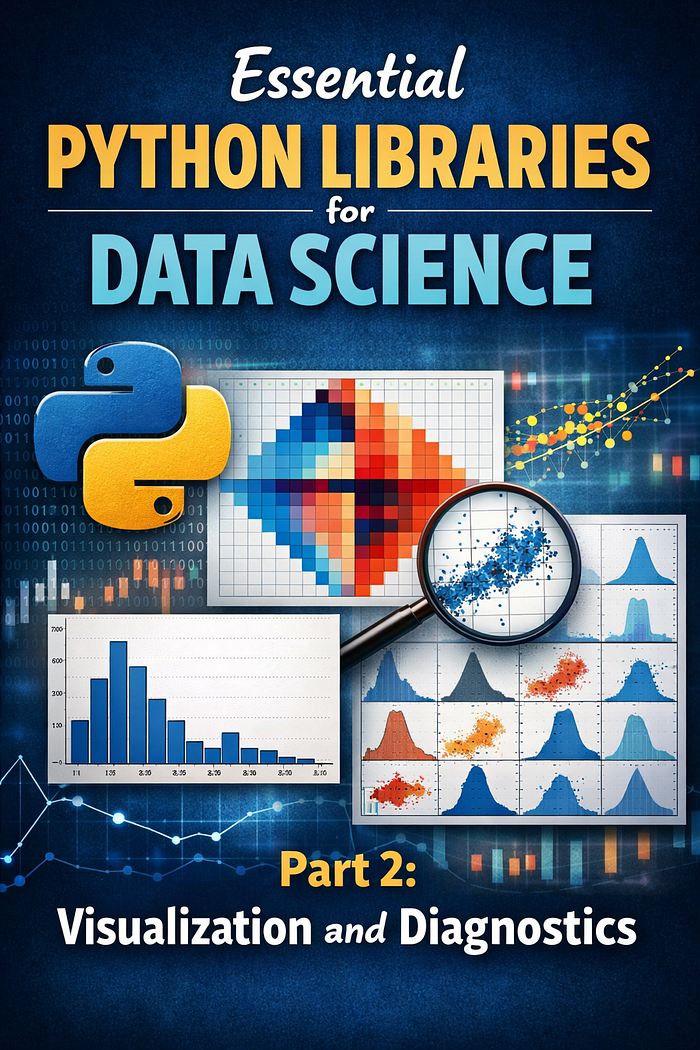
Essential Python Libraries for Data Science: Part 2 — Matplotlib, Seaborn, and Plotly
Last Updated on August 3, 2026 by Editorial Team
Author(s): Raj kumar
Originally published on Towards AI.
How Data Visualization Reveals Patterns, Validates Assumptions, and Builds Trust in Analytical Decisions
In Part 1, we built the foundations of the data pipeline. We loaded a real dataset, structured it using Pandas, selected relevant features, and performed numerical transformations using NumPy. By the end of Step 5 of the end-to-end workflow introduced in Part 1, the data had moved through its most critical early stages: cleaning, selection, and normalization. At that point, the dataset was technically ready for modeling.
After Part 1’s normalization, the article emphasizes that production-grade data science shouldn’t jump straight to modeling; instead, Part 2 uses visualization and diagnostics to inspect the already-prepared dataset. It walks through univariate distribution checks with Matplotlib (verifying centering, skew, heavy tails, and outliers), then moves to feature relationships and redundancy with Seaborn pair plots and correlation heatmaps to quantify dependencies and make explicit trade-offs rather than blindly dropping variables. Finally, it adds Plotly for interactive diagnostics—helping analysts explore dense regions and confirm whether patterns persist beyond a few extreme points. The piece concludes by framing diagnostics as a quality gate: recording observations that feed modeling decisions, reducing instability and misleading metrics, and ensuring continuity between analysis and the eventual scikit-learn modeling phase in Part 3.
Read the full blog for free on Medium.
Join thousands of data leaders on the AI newsletter. Join over 80,000 subscribers and keep up to date with the latest developments in AI. From research to projects and ideas. If you are building an AI startup, an AI-related product, or a service, we invite you to consider becoming a sponsor.
Published via Towards AI
Towards AI Academy
We Build Enterprise-Grade AI. We'll Teach You to Master It Too.
15 engineers. 100,000+ students. Towards AI Academy teaches what actually survives production.
Start free — no commitment:
→ AI Engineering For Production — our new book, coming before the end of 2026. Join the waitlist.
→ Agents Architecture Cheatsheet — 3 years of architecture decisions in 6 pages
Our courses:
→ AI Engineering Certification — 90+ lessons from project selection to deployed product. The most comprehensive practical LLM course out there.
→ Agent Engineering Course — Hands on with production agent architectures, memory, routing, and eval frameworks — built from real enterprise engagements.
→ AI for Work — Understand, evaluate, and apply AI for complex work tasks.
Note: Article content contains the views of the contributing authors and not Towards AI.
Related posts
Recent Posts


