Google Just Published the Blueprint. And aiHelpDesk Is Already Shipping it.
Last Updated on July 20, 2026 by Editorial Team
Author(s): Boris Dali
Originally published on Towards AI.

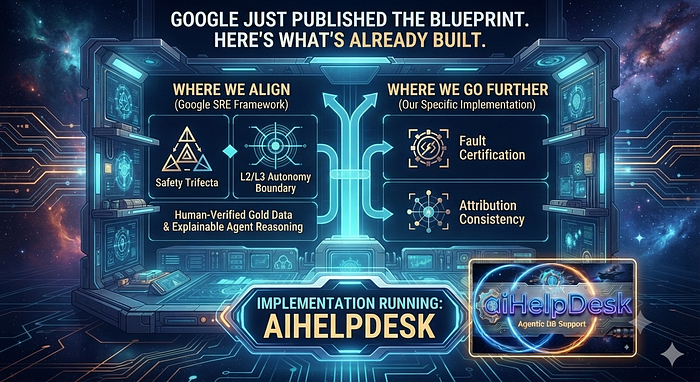
Google’s SRE team published an essay this week on integrating AI into production operations. It is worth reading in full. It is also, for anyone who has been following aiHelpDesk, striking for a different reason: Google independently arrived at the same core architecture we have been building. And published it as the standard the industry should aim for.
This post walks through that alignment and then explains where aiHelpDesk goes beyond what Google describes.
Google’s Safety Trifecta is aiHelpDesk’s Governance
Google names three requirements for safe AI autonomy in production:
- Transparency: chain-of-thought logging of every agent decision
- Real-time risk evaluation: assessing blast radius before any production action executes
- Progressive authorization: requiring human approval at increasing levels of consequence.
This is not a framework we need to implement. It is a description of what aiHelpDesk already ships:

Google built “Actus”, which is their Mitigation Safety Verification Agent. Actus appears to be the control plane that enforces these three properties. Actus performs pre-flight safety validations, mandatory dry-runs and maintains an emergency circuit breaker (“Red Button”) for pausing all agentic actions. aiHelpDesk’s Governance layer does the same work: the policy engine enforces what can run, the blast radius check is the pre-flight and gate denial is the circuit breaker. All of that is recorded permanently in the audit log alongside the operator identity and stated reason.
We also refer to the above as the WHAT vs. the WHY framework.
We did not copy Google. They did not copy us. Two teams working on the same hard problem arrived at the same answer. That is the strongest possible signal that the answer is right.
Their autonomy levels are useful vocabulary for aiHelpDesk’s positioning
Google defines five levels of SRE autonomy (L0–L4):
- L0 — Manual: human executes everything
- L1 — Assisted: monitoring and investigation automated, human decides
- L2 — Partial autonomy: human approval required for actions
- L3 — High autonomy: autonomous in bounded, certified scenarios
- L4 — Full autonomy: multi-step resolution without human involvement
aiHelpDesk’s default mode is L2. The step-approval gate is the L2 mechanism: the agent diagnoses and proposes, a human reviews the blast radius and approves each consequential step. Nothing destructive executes without that approval.
The path to L3 in aiHelpDesk is the stability cert. When a fault class has accumulated sufficient certified runs, e.g. STABLE(7) attr=oom-kill (7/7) with the judge consistency 94%, the cert becomes an evidence that the agent’s reasoning on this specific fault class is reliable enough to reduce the approval burden. L3 is not a mode you flip on. It is a level of trust you earn, per fault class, per model, with data behind it. See here for details.
L4 is explicitly not our target. Full autonomy on the mission critical production database and K8s systems without human involvement in the loop is not a goal aiHelpDesk will pursue. The Judgment Layer is expensive, but it exists precisely because there is a class of decisions that requires operational experience the agent cannot synthesize from traces alone. aiHelpDesk knows which recommendation to prohibit and why.
Where aiHelpDesk goes further than Google blueprint describes
Google’s evaluation framework is thorough: Bronze/Silver/Gold data quality tiers, LLM-as-judge, nightly runs against past incidents, IRM-Analyzer reconstructing human response trajectories. This is serious engineering and their MTTM numbers (44% reduction for supported incidents) reflect it.
But Google’s evaluation is entirely backward-looking. Did the agent handle past incidents correctly? The dataset is real incidents. That effectively makes the measurement retrospective.
aiHelpDesk’s approach is forward-looking. The fault catalog contains 32 structured fault scenarios [code link]. Each with an injection spec, a teardown and an expected attribution class. aiHelpDesk fault injection testing system injects the fault, the agent diagnoses it, the judge evaluates the diagnosis and the result is recorded in a stability cert that carries forward as a per-fault guarantee:
fault: k8s-oomkilled playbook: pbs_k8s_pod_crash_triage taxonomy: 1.0
runs: 7 pass: 7/7 (100%) STABLE(7) attr=oom-kill (7/7) judge: 94%±3%
This cert is not a quality process report. It is a proof. It says: on this specific fault class, under this playbook version, with this model, the agent reached the correct attribution conclusion seven times in a row with 94% judge consistency. That is a different kind of claim than “we run nightly evaluations.”
Google describes three tiers of data quality: Bronze (heuristic), Silver (programmatic) and Gold (human-verified). aiHelpDesk’s vault calibration shows the same distinction. The output explicitly flags when the human feedback fraction is thin and the accuracy figure reflects LLM self-consistency rather than verified verdicts. We call it a Data Quality Banner. The principle is identical: you are entitled to know when the number you are looking at is based on a shallow signal.
The dimension Google does not describe at all is attribution consistency. Not just “did the agent pass”, but “did the agent reach the same conclusion every time, and can we name that conclusion?” Two agents can both pass on a K8s Pod crash fault and reach opposite conclusions: one diagnoses oom-kill (exit code 137, memory limit exceeded), the other diagnoses process-error (exit code 1, configuration failure). Same playbook, same pass rate, different reasoning. See here for the full story.
aiHelpDesk’s cert captures the attribution:
fault: k8s-oomkilled STABLE(7) attr=oom-kill (7/7)
fault: k8s-crashloop STABLE(5) attr=process-error (5/5)
An agent that passes, but cannot consistently name what it found is not production-certified on that fault class. Attribution consistency is the difference between a system that gets the right answer and one that knows why.
The open-source difference
Google’s entire stack is internal. Detectr, AI Alert, Incident Hypothesis, Investigation Dashboards, AI Operator, Actus. All of it appears to be internal. It cannot be audited, forked or deployed. The essay is the blueprint. The implementation is not available.
aiHelpDesk is open source. The governance layer, the audit trail, the blast radius enforcement, the step-approval gate, the fault catalog, the evaluation pipeline. All of it is in the public repository. The code, the commit history. Fully verifiable. Every claim in the Customer Bill of Rights has a mechanism you can read, test and confirm is real. On a live system. Your system.
A company that reads Google’s essay and asks “how do we get this for our database and K8s operations?” has two options: build it internally over two to three years or use aiHelpDesk today.
What the blueprint confirms
The governance architecture for safe AI in production operations is not experimental. Google runs it at scale, across thousands of incidents and publishes the results. The Safety Trifecta is real. The L2/L3 autonomy boundary is real. The need for human-verified gold data and explainable agent reasoning is real.
aiHelpDesk implements this architecture, open source, for production database and K8s operations, with the addition of forward-looking fault certification and attribution consistency that Google’s essay does not describe.
The blueprint has been published. The implementation has been running.
aiHelpDesk invented and pioneered the concepts of Operational SRE/DBA Flywheel (blog post, doc), Triage Consistency Certification, Informed Consent, Second Opinion and Bill of Rights.
The vault commands, the Judge, the playbook diff, the full audit trail, the calibration data quality banner, the model-scoped stability certs and vault cert-compare… are not add-ons. They are the product. Trust is the product. The Judgment Layer covers what to do when the AI’s own improvement proposals fail. And why that case is where the most durable operational knowledge gets encoded.
Why aiHelpDesk Playbooks are trustworthy?
Because we give you, the customer, an ability to vet, verify and improve them through the methodology that we refer to as Operational SRE/DBA Flywheel, see here and here for details.

And yes, as a customer, you can not only confirm that the playbooks that you get with aiHelpDesk out of the box work for your environment, but you can easily bring your own. Both: BYO playbooks (by either importing your existing runbooks or cloning and customizing one of our’s or by creating one from scratch) + BYO faults as well.
Because nobody knows your specific databases, your environment and your workload with your upstream/downstream apps better than you do. You know how your database fails. Vendors don’t. At aiHelpDesk, we give you an option to create your own faults and add your own playbooks to triage and rectify them (in addition to the system playbooks we ship, of course).
And yes, we don’t depend on a particular model or a model provider. aiHelpDesk is model-neutral. From our standpoint, the LLMs are a disposable commodity. Flip from Gemini to Anthropic and aiHelpDesk should continue to give you exactly the same diagnosis and remediation. Anything shorter than that is a P0 bug.
Related Reading
- aiHelpDesk Flywheel official documentation
- Your SRE On-Call Runbook Is Already Obsolete. Here’s Why That’s Not Your Fault: Introducing aiHelpDesk Operational SRE/DBA Flywheel
- The Missing Test Suite for AI Database Operations: You’re about to bet your SRE/DBA on-call rotation on an AI agent. Want to know if it’s any good before the 2am page goes off?
- Runbooks Rot. Playbooks Learn: Operational SRE/DBA Flywheel: Ops Knowledge That Compounds. Automatically. Improving with every incident
- We Wanted a Dramatic AI Agent Failure. We Got Something Better:
When the Flywheel works: The K8s WAL fault that made us rethink what playbooks are for - AI Database Troubleshooting: the PostgreSQL Stat That Looks Like Good News (But Ain’t): What a bgwriter incident taught us about the difference between reading data and understanding it
- AI troubleshooted DB pileup and reported success. The locks didn’t care: It’s the story that shows that the model wasn’t bad at reasoning. But it reasoned without the right knowledge.
- Your AI Just Diagnosed the Outage. Should It Fix It Too? How Decision Hub puts a human at every boundary between knowing and doing. And how we tried to override our own governance model and it said no. Twice.
As of this writing, aiHelpDesk is available in Beta. If you run PostgreSQL in production and would like to get help in preparing for the avalanche, consider aiHelpDesk. Reach out to us at info@aiHelpDesk.biz and we’ll be happy to show you what it looks like in practice.
Join thousands of data leaders on the AI newsletter. Join over 80,000 subscribers and keep up to date with the latest developments in AI. From research to projects and ideas. If you are building an AI startup, an AI-related product, or a service, we invite you to consider becoming a sponsor.
Published via Towards AI
Towards AI Academy
We Build Enterprise-Grade AI. We'll Teach You to Master It Too.
15 engineers. 100,000+ students. Towards AI Academy teaches what actually survives production.
Start free — no commitment:
→ 6-Day Agentic AI Engineering Email Guide — one practical lesson per day
→ Agents Architecture Cheatsheet — 3 years of architecture decisions in 6 pages
Our courses:
→ AI Engineering Certification — 90+ lessons from project selection to deployed product. The most comprehensive practical LLM course out there.
→ Agent Engineering Course — Hands on with production agent architectures, memory, routing, and eval frameworks — built from real enterprise engagements.
→ AI for Work — Understand, evaluate, and apply AI for complex work tasks.
Note: Article content contains the views of the contributing authors and not Towards AI.
Related posts
Recent Posts