If You’re a Python Developer, These 7 AI APIs Could Be Your Biggest Advantage in 2026.
Last Updated on June 8, 2026 by Editorial Team
Author(s): PhynixAI
Originally published on Towards AI.
If You’re a Python Developer, These 7 AI APIs Could Be Your Biggest Advantage in 2026.
From intelligent assistants to AI-powered products, these APIs are becoming essential tools in every modern Python developer’s toolkit.
Python isn’t just the most popular language anymore it’s the language of AI. As of March 2026, Python holds the #1 position on the TIOBE Index with 21.25% share, having overtaken JavaScript as the most-used language on GitHub in 2025. If you’re a Python developer and you haven’t started integrating AI APIs into your stack, you’re leaving serious capability — and money — on the table.
The good news? The cost barrier has collapsed. What used to cost $30/million tokens now costs under $0.50. New players like DeepSeek have forced every major provider to cut prices aggressively. The result is a golden window where you can build things in 2026 that were economically impossible in 2024.
“The right question isn’t which model costs less per token. It’s which model costs less per business outcome.”
I’ve broken down the seven APIs that are actually worth integrating covering LLMs, voice synthesis, image generation, and the budget wildcards that could 10× your productivity on a fraction of the spend.

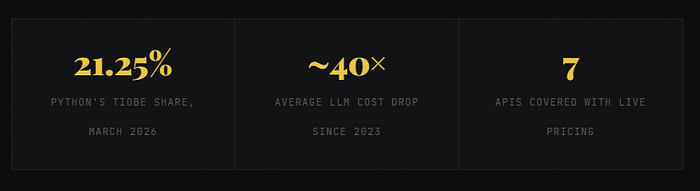
📊 By the Numbers
- 21.25% Python’s TIOBE index share, March 2026
- ~40× Average LLM cost drop since 2023
- 7 APIs covered, with live 2026 pricing

01. OpenAI API
Category: LLM · Multimodal
The original benchmark. OpenAI’s GPT family remains the most battle-tested API in production, with the widest ecosystem of tooling, frameworks, and community support. The 2026 lineup now spans from the ultra-cheap GPT-4.1 Nano all the way to the flagship GPT-5.5, released April 2026.
2026 Pricing (per 1M tokens):

Quick Start:
from openai import OpenAI
client = OpenAI(api_key="your-key")
response = client.chat.completions.create(
 model="gpt-5.4",
 messages=[{"role": "user", "content": "Summarize this report"}],
 max_tokens=500
)
print(response.choices[0].message.content)
Best for: Production apps that need the broadest ecosystem support, reliable uptime, and the most mature function-calling/tool-use implementation. The Batch API gives you 50% off for async workloads massive for data pipelines.
💡 Pro tip: Route simple tasks to GPT-4.1 Nano (10–50× cheaper) and escalate to GPT-5.4 only when needed.
Use cases: Chatbots · Code generation · Vision tasks · Function calling · Structured outputs
02. Anthropic Claude API
Category: LLM · Long Context
Claude’s biggest advantage over the competition isn’t the prose quality it’s the context window. Claude Opus 4.7 supports a 1 million token context, compared to GPT-4o’s 128K. For Python devs working on RAG pipelines, document analysis, or long-form code review, that’s a fundamental architectural advantage. And the 90% prompt caching discount is the most aggressive in the industry.
2026 Pricing (per 1M tokens):

Quick Start:
import anthropic
client = anthropic.Anthropic(api_key="your-key")
message = client.messages.create(
 model="claude-sonnet-4-6",
 max_tokens=1024,
 system="You are a helpful Python expert.",
 messages=[{
 "role": "user",
 "content": "Review this codebase for bugs"
 }]
)
print(message.content[0].text)
Best for: Any workflow involving large codebases, lengthy documents, or complex multi-step reasoning. Claude Sonnet 4.6 at $3/$15 is the sweet spot a best-value flagship that punches above its weight. Use Haiku 4.5 for high-volume classification and routing tasks.
Use cases: Long doc analysis · RAG pipelines · Code review · Agentic workflows · Complex reasoning
03. Google Gemini API
Category: Multimodal · 2M Context
Google’s play is ecosystem lock-in done right. Gemini 3.1 Pro, released February 2026, supports a 2 million token context window the largest available anywhere. If you’re building on Google Cloud, BigQuery, or Vertex AI, the native integrations are unmatched. The free tier is also the most generous in the market.
2026 Pricing (per 1M tokens):

Quick Start:
import google.generativeai as genai
genai.configure(api_key="your-key")
model = genai.GenerativeModel("gemini-3.1-pro")
response = model.generate_content(
 "Analyze this dataset and find anomalies"
)
print(response.text)
Best for: Google Cloud — native stacks and any use case requiring the maximum context window. Note: Gemini 3.1 Pro is paid-only as of April 1, 2026. Beware cost cliffs input pricing doubles above 200K tokens. The Batch API cuts costs 50% for async workloads.
💡 Pro tip: Gemini 3.1 Pro is roughly 2.5× cheaper than GPT-5.5 per token. For heavy reasoning at scale, the savings are substantial.
Use cases: PhD-level reasoning · 2M context RAG · Multimodal (audio/video) · Google Cloud integration · Budget workloads
04. DeepSeek API
Category: Budget Champion
DeepSeek is the price disruptor that forced everyone else’s hand. The numbers are almost absurd: V4 delivers GPT-5-class performance at roughly 1/10th the price. R1 offers o1-class reasoning at 1/27th the cost of OpenAI’s equivalent. For Python developers building high-volume agents, data pipelines, or automated testing this is the cost lever that changes the math entirely.
2026 Pricing (per 1M tokens):

Quick Start (OpenAI-compatible — change 2 lines):
from openai import OpenAI
# DeepSeek is OpenAI-compatible
client = OpenAI(
 api_key="your-deepseek-key",
 base_url="https://api.deepseek.com"
)
response = client.chat.completions.create(
 model="deepseek-v4-pro",
 messages=[{"role": "user", "content": "Write Python unit tests"}]
)
print(response.choices[0].message.content)
Best for: Any workload where cost is the binding constraint and data sensitivity is low. The API is OpenAI-compatible literally change two lines of code. New accounts get 5M free tokens, no card required.
⚠️ Critical caveat: Do not send PII or sensitive regulated data to DeepSeek’s servers. For production, use Context Caching aggressively it’s the single biggest lever for cost reduction.
Use cases: High-volume agents · Code review pipelines · Data extraction · Automated testing · Math/reasoning chains
05. ElevenLabs API
Category: Voice Synthesis
If your Python app needs to speak, ElevenLabs is the gold standard and it’s not close. The platform has evolved from a TTS tool into a full voice ecosystem covering voice cloning, dubbing in 29+ languages, sound effects, music generation, and conversational AI agents. The Multilingual v2 model outputs 192kbps audio with naturalness that still surprises experienced developers.
2026 Pricing:
Plan Price Credits/Month Commercial Rights Free Tier $0 10,000 (~10 min) ✗ No Starter $5/mo 30,000 (~30 min) ✓ Yes Creator $22/mo 100,000 ✓ Yes API Pro $99/mo 100 API credits ✓ Yes
Quick Start:
from elevenlabs import ElevenLabs
client = ElevenLabs(api_key="your-key")
audio = client.text_to_speech.convert(
 voice_id="21m00Tcm4TlvDq8ikWAM",
 model_id="eleven_multilingual_v2",
 text="Hello from your Python app!"
)
# Stream or save audio bytes
with open("output.mp3", "wb") as f:
 for chunk in audio:
 f.write(chunk)
Best for: Any Python application that needs human-quality voice output from content pipelines to conversational agents. Important: the subscription and API are billed separately. Creator at $22/month is the best value for most developers.
Use cases: Audiobook generation · Podcast automation · Voice cloning · Conversational AI · Multilingual dubbing
06. Stability AI API
Category: Image Generation
The image generation market has fragmented, and that’s good news for developers. Stability AI remains the most flexible option for Python devs who need fine-grained control over outputs particularly for fine-tuning workflows. SD 3.5 Large produces images competitive with Midjourney at $0.065/image.
2026 Pricing Comparison (per image):

Quick Start:
import requests
response = requests.post(
 "https://api.stability.ai/v2beta/stable-image/generate/core",
 headers={"Authorization": "Bearer your-key"},
 files={"none": ""},
 data={
 "prompt": "photorealistic mountain at golden hour",
 "output_format": "webp"
 }
)
with open("output.webp", "wb") as f:
 f.write(response.content)
Best for: Visual content pipelines, e-commerce product imagery, and workflows requiring programmatic image generation at scale. Stability AI offers 25 free images/month for testing.
⚠️ Scale trap: At 10,000 images/day, a $0.04/image API costs $12,000/month. Choose your provider carefully based on volume.
Use cases: Product mockups · Content automation · Fine-tuned models · Batch generation · E-commerce imagery
07. Hugging Face Inference API
Category: Open Source · 300K+ Models
If the first six APIs are the commercial options, Hugging Face is the open-source powerhouse. Over 300,000 models covering every conceivable task NLP, computer vision, audio, tabular data available behind a single unified API. For Python developers who need custom fine-tuned models or simply want zero vendor lock-in, this is home base.
2026 Pricing:

Quick Start:
from huggingface_hub import InferenceClient
client = InferenceClient(
 model="meta-llama/Llama-3.3-70B-Instruct",
 token="your-hf-token"
)
response = client.chat_completion(
 messages=[{"role": "user", "content": "Classify this review"}]
)
print(response.choices[0].message.content)
Best for: Domain-specific tasks, fine-tuned models, and any workflow that needs open-weight LLMs like Llama 3.3 or Mistral without licensing costs. The free Serverless tier is genuinely useful for prototyping.
Use cases: Custom fine-tuning · Sentiment analysis · Medical NLP · Open-source LLMs · Zero vendor lock-in
QUICK REFERENCE:


The Python Developer’s 2026 Strategy
Don’t pick one API and lock in. The smartest developers in 2026 are building routing layers sending simple tasks to DeepSeek or Gemini Flash at $0.10–0.50/M tokens, escalating complex reasoning to Claude Opus or GPT-5.5, and using ElevenLabs and Stability AI for media-rich features.
The infrastructure cost of building AI features is now negligible. The competitive advantage isn’t access to models it’s knowing which model to use, when.
The window to build differentiated AI-powered products is narrowing not because the technology is getting harder to access, but because it’s getting easier. Every developer has the same tools. The advantage goes to the ones who actually integrate them thoughtfully.
Pick two or three APIs that match your current project. Ship something. Iterate. That’s the only strategy that matters.
Join thousands of data leaders on the AI newsletter. Join over 80,000 subscribers and keep up to date with the latest developments in AI. From research to projects and ideas. If you are building an AI startup, an AI-related product, or a service, we invite you to consider becoming a sponsor.
Published via Towards AI
Towards AI Academy
We Build Enterprise-Grade AI. We'll Teach You to Master It Too.
15 engineers. 100,000+ students. Towards AI Academy teaches what actually survives production.
Start free — no commitment:
→ 6-Day Agentic AI Engineering Email Guide — one practical lesson per day
→ Agents Architecture Cheatsheet — 3 years of architecture decisions in 6 pages
Our courses:
→ AI Engineering Certification — 90+ lessons from project selection to deployed product. The most comprehensive practical LLM course out there.
→ Agent Engineering Course — Hands on with production agent architectures, memory, routing, and eval frameworks — built from real enterprise engagements.
→ AI for Work — Understand, evaluate, and apply AI for complex work tasks.
Note: Article content contains the views of the contributing authors and not Towards AI.
Related posts
Recent Posts