LLM Observability Tools Compared: MLflow vs. Langfuse vs. Confident AI
Last Updated on July 27, 2026 by Editorial Team
Author(s): allglenn
Originally published on Towards AI.
The 2 a.m. page that tracing can’t explain
A support bot answers a billing question with total confidence and gets the refund policy wrong. Nobody notices for three days because the response looked fine: grammatically correct, on-topic, politely worded. It just wasn’t true. When someone finally flags it, an engineer pulls up the logs and finds one line: a request ID, a 200 status code, a latency number. The actual conversation is gone. The retrieved documents, the system prompt, the tool calls, the reasoning steps, whatever confidence the model had in its own answer. None of it was ever captured.
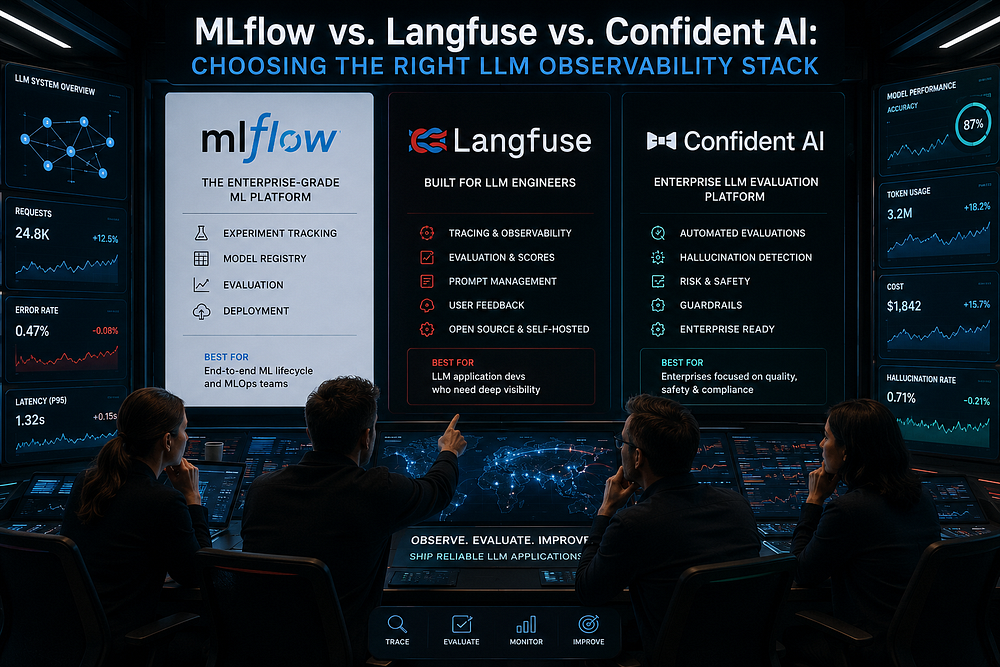
The article explains that “LLM observability” isn’t just tracing and monitoring—it’s about treating “was the output actually good” as a first-class signal alongside latency and errors. It compares MLflow, Langfuse, and Confident AI by breaking down a shared architecture pattern (instrumentation, trace storage, trace UI, evaluation, and regression/CI gating), then highlights how each tool started from a different core: MLflow extends the ML lifecycle world with tracing, prompts, and evaluation but with a less specialized eval layer; Langfuse focuses on LLM-app engineering with a flexible data model, strong prompt/versioning and trace inspection, and customizable evaluation; and Confident AI is evaluation-first, built on DeepEval with broad metric coverage and workflows designed to feed scores back into regression tests and deployment gates. It concludes with practical decision guidance (trace vs evaluation needs, existing infra, self-hosting realism, who must participate in quality review) and a recommended implementation mindset: pilot on real workflows, test worst-case nested traces, use OpenTelemetry conventions when possible, set cost alerts early, calibrate metrics to domain expectations, and—most importantly—build the full loop from production failures to regression datasets and CI gating.
Read the full blog for free on Medium.
Join thousands of data leaders on the AI newsletter. Join over 80,000 subscribers and keep up to date with the latest developments in AI. From research to projects and ideas. If you are building an AI startup, an AI-related product, or a service, we invite you to consider becoming a sponsor.
Published via Towards AI
Towards AI Academy
We Build Enterprise-Grade AI. We'll Teach You to Master It Too.
15 engineers. 100,000+ students. Towards AI Academy teaches what actually survives production.
Start free — no commitment:
→ 6-Day Agentic AI Engineering Email Guide — one practical lesson per day
→ Agents Architecture Cheatsheet — 3 years of architecture decisions in 6 pages
Our courses:
→ AI Engineering Certification — 90+ lessons from project selection to deployed product. The most comprehensive practical LLM course out there.
→ Agent Engineering Course — Hands on with production agent architectures, memory, routing, and eval frameworks — built from real enterprise engagements.
→ AI for Work — Understand, evaluate, and apply AI for complex work tasks.
Note: Article content contains the views of the contributing authors and not Towards AI.
Related posts
Recent Posts