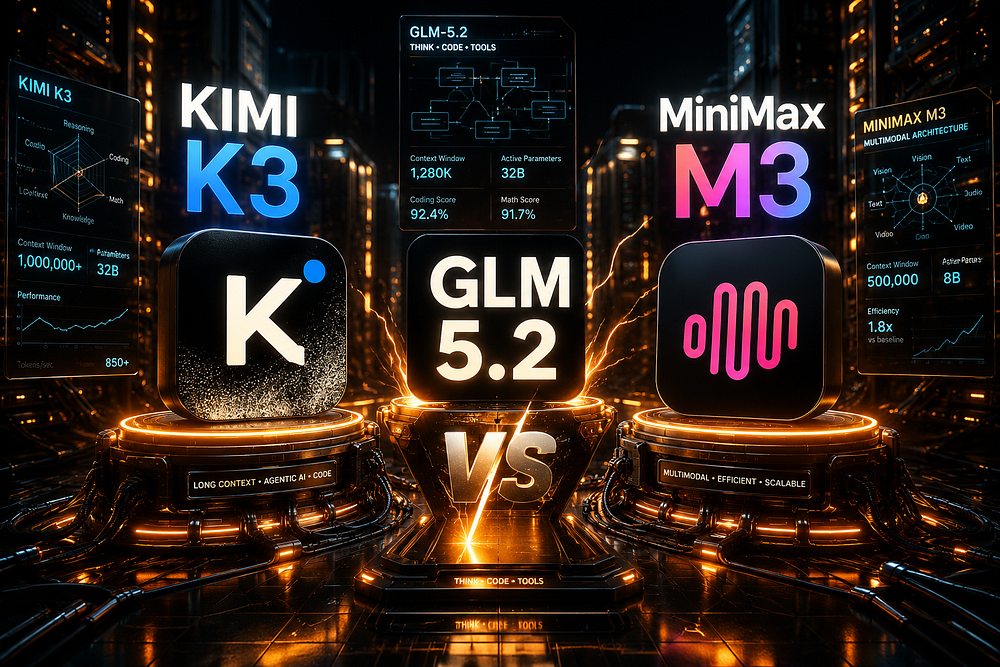
MiniMax M3 vs GLM-5.2 vs Kimi K3: which open-weight model should you actually self-host for agentic coding?
Last Updated on July 27, 2026 by Editorial Team
Author(s): allglenn
Originally published on Towards AI.
MiniMax M3, GLM-5.2, and Kimi K3 compared on VRAM, license, and agent-loop latency: the real decision tree for self-hosting an open-weight coding model i
A team I know spent an entire sprint provisioning an 8-GPU node. Turned out they could have run the same model at a quarter of the cost, on half the GPUs, with a different quantization format. Nobody had done the arithmetic. They’d done the leaderboard comparison instead: SWE-Bench Pro score, sorted descending, top result wins.
The article argues that benchmark leaderboards are an incomplete guide to whether an open-weight coding agent model will actually work for a given deployment. It explains the key factors that matter in practice—VRAM sizing (especially KV-cache vs weights), license constraints (e.g., MIT vs “modified MIT”), and real agent-loop latency rather than vendor throughput—and then compares MiniMax M3 (sparse attention for cheaper long-context decoding), GLM-5.2 (744B MIT-licensed MoE with mature vLLM quantization/self-hosting options), and Kimi K3 (2.8T extremely sparse/linear-attention design that is currently API-only because weights aren’t public yet). It includes a step-by-step vLLM walkthrough for self-hosting GLM-5.2 on a 4-GPU node, discusses real-world fit cases for different teams and workloads, highlights common failure modes (like sizing only weights, KV-cache mistakes, and assuming benchmark transferability), and finishes with best practices and a decision guide for choosing which model to self-host now versus evaluate via hosted access while waiting for future releases.
Read the full blog for free on Medium.
Join thousands of data leaders on the AI newsletter. Join over 80,000 subscribers and keep up to date with the latest developments in AI. From research to projects and ideas. If you are building an AI startup, an AI-related product, or a service, we invite you to consider becoming a sponsor.
Published via Towards AI
Towards AI Academy
We Build Enterprise-Grade AI. We'll Teach You to Master It Too.
15 engineers. 100,000+ students. Towards AI Academy teaches what actually survives production.
Start free — no commitment:
→ 6-Day Agentic AI Engineering Email Guide — one practical lesson per day
→ Agents Architecture Cheatsheet — 3 years of architecture decisions in 6 pages
Our courses:
→ AI Engineering Certification — 90+ lessons from project selection to deployed product. The most comprehensive practical LLM course out there.
→ Agent Engineering Course — Hands on with production agent architectures, memory, routing, and eval frameworks — built from real enterprise engagements.
→ AI for Work — Understand, evaluate, and apply AI for complex work tasks.
Note: Article content contains the views of the contributing authors and not Towards AI.
Related posts
Recent Posts