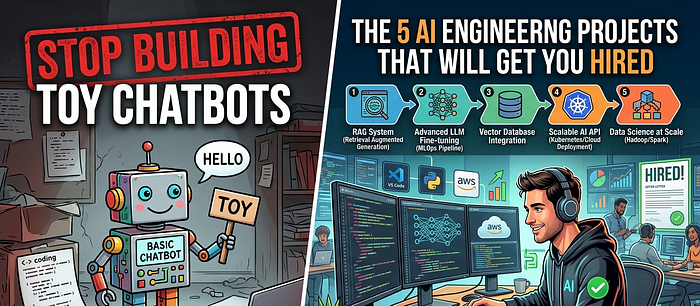
Stop Building Toy Chatbots: The 5 AI Engineering Projects That Will Get You Hired
Last Updated on July 27, 2026 by Editorial Team
Author(s): Ananya Kaul
Originally published on Towards AI.

Here are 5 production-grade architectures that prove you actually know how to build real AI systems.
If you put a basic “PDF Chatbot with LangChain and Streamlit” on your resume today, most engineering managers will swipe left in under five seconds.
Why? Because calling an API with three lines of boilerplate code isn’t AI engineering — it’s basic scripting.
In 2026, tech companies aren’t looking for developers who can connect an LLM to a vector store. They want engineers who understand system latency, evaluation loops, stateful multi-agent workflows, and cost guardrails.
If you want to stand out in a sea of generic GenAI portfolios, here are the 5 production-grade projects you need to build — and exactly what to include in each.
1. Agentic RAG with Corrective Feedback & Re-ranking
Standard RAG (Retrieval-Augmented Generation) breaks down the moment a query is ambiguous or the vector search returns low-quality chunks. An agentic RAG system doesn’t just blindly pass retrieved context to the LLM—it dynamically evaluates and refines its own search strategy.
What to Build:
- Query Rewriter: If context retrieval score is low, transform the query using an LLM step.
- Hybrid Search + Cross-Encoder Re-ranking: Combine PostgreSQL keyword search (
BM25) withpgvectorsemantic search, followed by a re-ranker (e.g., Cohere or BGE). - Document Grader: A lightweight model pass to verify if retrieved documents actually answer the user query before sending them to the final model.
# Conceptual loop using LangGraph or custom state machine
def grade_retrieved_docs(state):
 docs = state["documents"]
 question = state["question"]

 relevant_docs = []
 for doc in docs:
 if document_evaluator.is_relevant(doc, question):
 relevant_docs.append(doc)

 # Fallback if no relevant docs found: trigger query re-write or web search
 if not relevant_docs:
 return "rewrite_query"
 return "generate_answer"
Why it gets you hired: It proves you understand that vector retrieval isn’t 100% accurate and that you know how to build fault-tolerant retrieval pipelines.
2. Multi-Agent Systems with State & Tool Calling (LangGraph / CrewAI)
Single-prompt completion models fail when tasks require multiple steps, memory, and specialized tool executions. A multi-agent framework splits complex goals into dedicated roles (e.g., Researcher, Coder, Evaluator) that communicate via shared state.
What to Build:
Build an Automated Code Review & Security Auditor Agent that:
- Receives a GitHub Pull Request URL.
- Uses a Fetcher Agent to pull the git diff.
- Passes the diff to a Linter Agent to run static analysis tools.
- Passes the diff to a Security Agent to inspect for common vulnerabilities (e.g., hardcoded API keys, SQL injection).
- Aggregates results into a structured markdown report and posts it back to the PR.
Key Feature to Implement: Add a Human-in-the-Loop checkpoint where a user must approve high-severity security actions before any auto-remediation PR is created.
3. Production Evaluation & Observability Pipeline (LLM-as-a-Judge)
Most AI projects fail to reach production because teams have no systematic way to measure whether a prompt change broke expected outputs.
Building an Eval Pipeline proves you think like a software engineer, not just an experimental prompt crafter.
What to Build:
- Create an automated testing suite using Ragas or TruLens integrated into a CI/CD pipeline (e.g., GitHub Actions).
- Benchmark your LLM app across 4 key metrics:
- Faithfulness: Does the answer rely only on context?
- Answer Relevance: Does it directly answer the user prompt?
- Context Precision: Are the retrieved context chunks noise-free?
- Latency & Token Cost: Cost per request tracking.
# Simple assertion check pattern for CI/CD pipelines
from ragas import evaluate
from ragas.metrics import faithfulness, answer_relevance
def run_evaluation_suite(test_dataset):
 results = evaluate(
 dataset=test_dataset,
 metrics=[faithfulness, answer_relevance]
 )

 # Block PR deployment if quality drops below threshold
 assert results["faithfulness"] >= 0.85, "Faithfulness score below threshold!"
 assert results["answer_relevance"] >= 0.90, "Relevance score below threshold!"
4. Edge LLM Fine-Tuning & Quantized Serving (vLLM / Ollama / SLMs)
Sending every simple task to a cloud-hosted frontier model is expensive and slow. Companies want to deploy smaller, highly specialized Small Language Models (SLMs like Phi-3, Llama-3–8B, or Qwen2) on self-hosted infrastructure.
What to Build:
- Take an open-source 8B parameter model and fine-tune it using QLoRA on a specific task (e.g., converting unstructured customer emails into exact JSON format).
- Quantize the model (GGML/AWQ) down to 4-bit precision.
- Serve the model using vLLM or TGI (Text Generation Inference) inside a Docker container behind a FastAPI gateway.
Why it gets you hired: Demonstrates real MLOps, model quantization, containerization, and cost optimization skills that directly impact a company’s bottom line.
5. Real-Time Multimodal Voice Agent (WebRTC + Streaming API)
Text chatbots are oversaturated. Real-time streaming voice/vision interactions represent the cutting edge of AI product engineering.
What to Build:
Build a Real-Time Interactive AI Technical Interviewer using streaming protocols:
- Speech-to-Text (STT): Deepgram or Whisper with streaming WebSocket connection.
- LLM Engine: Fast token streaming (e.g., Claude Sonnet or GPT-4o mini).
- Text-to-Speech (TTS): ElevenLabs or Cartesia with ultra-low latency audio chunks.
- WebRTC Integration: Handle audio input/output seamlessly in the browser with sub-800ms end-to-end response times.
# Handling streaming audio chunks over WebSocket
@app.websocket("/ws/audio")
async def handle_audio_stream(websocket: WebSocket):
 await websocket.accept()
 async for chunk in websocket.iter_bytes():
 # Stream raw audio bytes directly to STT engine
 transcript = await stt_service.stream_transcribe(chunk)
 if transcript.is_final:
 # Stream LLM tokens to TTS immediately
 async for audio_chunk in tts_service.stream_response(transcript.text):
 await websocket.send_bytes(audio_chunk)
The Formula for Your Portfolio Readme
No matter which 3 of these 5 projects you choose to build, follow this exact structure in your GitHub repositories:
- Architecture Diagram: Use Mermaid.js or Excalidraw to show data flow visually.
- Metrics & Trade-offs: Show latency (p95), cost per 1k requests, and evaluation scores.
- Reproducible Setup: A clean
docker-compose.ymlso anyone can launch it locally in under two minutes.
Join thousands of data leaders on the AI newsletter. Join over 80,000 subscribers and keep up to date with the latest developments in AI. From research to projects and ideas. If you are building an AI startup, an AI-related product, or a service, we invite you to consider becoming a sponsor.
Published via Towards AI
Towards AI Academy
We Build Enterprise-Grade AI. We'll Teach You to Master It Too.
15 engineers. 100,000+ students. Towards AI Academy teaches what actually survives production.
Start free — no commitment:
→ 6-Day Agentic AI Engineering Email Guide — one practical lesson per day
→ Agents Architecture Cheatsheet — 3 years of architecture decisions in 6 pages
Our courses:
→ AI Engineering Certification — 90+ lessons from project selection to deployed product. The most comprehensive practical LLM course out there.
→ Agent Engineering Course — Hands on with production agent architectures, memory, routing, and eval frameworks — built from real enterprise engagements.
→ AI for Work — Understand, evaluate, and apply AI for complex work tasks.
Note: Article content contains the views of the contributing authors and not Towards AI.
Related posts
Recent Posts