
Surviving the Tectonic Shifts in Large Language Model Scaling: A Field Guide for Practitioners
Last Updated on July 16, 2026 by Editorial Team
Author(s): Hayanan
Originally published on Towards AI.
In January 2025, DeepSeek released a technical report that caused OpenAI, Anthropic, and Google to convene emergency meetings. The report described a frontier language model 671 billion parameters, performance matching GPT-4 on virtually every benchmark trained for approximately $5.6 million. Comparable models had cost an estimated $78 million to $120 million. The week the report dropped, NVIDIA’s market cap fell $590 billion in a single day. The reason for the panic was not that DeepSeek had found a shortcut around the scaling laws. The panic was that they hadn’t they had just found a smarter point on the same laws that everyone else was navigating, while most of the industry was watching the wrong axis.
In January 2025, DeepSeek released a technical report that caused OpenAI, Anthropic, and Google to convene emergency meetings. The report described a frontier language model 671 billion parameters, performance matching GPT-4 on virtually every benchmark trained for approximately $5.6 million. Comparable models had cost an estimated $78 million to $120 million. The week the report dropped, NVIDIA’s market cap fell $590 billion in a single day. The reason for the panic was not that DeepSeek had found a shortcut around the scaling laws. The panic was that they hadn’t they had just found a smarter point on the same laws that everyone else was navigating, while most of the industry was watching the wrong axis.
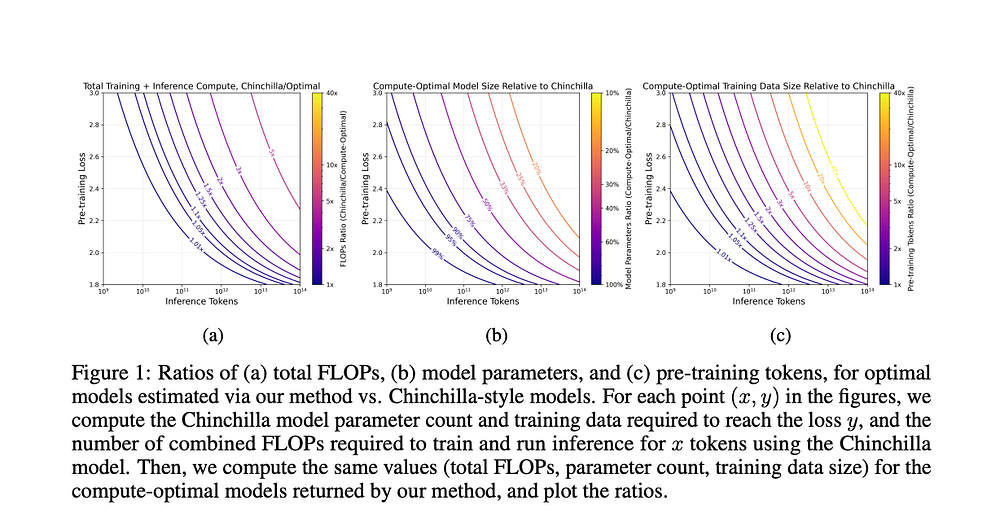
After the lead, the article reframes LLM progress as a sequence of “tectonic shifts” that each corrected a missing dimension in the previous scaling view. It walks through: Kaplan et al.’s original power-law framework (and what it didn’t address about deployability), the Chinchilla shift toward optimal training compute splits (and the “Chinchilla trap” where inference cost flips the optimal ratio), the rise of post-training (especially RLHF and newer alignment variants), the emerging data wall and practical tactics like filtering, synthetic data, and repeated token training, and architecture changes beyond pure Transformers (SSMs/Mamba, linear attention, and MoE) driven by long-context efficiency. It then emphasizes intelligence at inference time—where “thinking longer” changes capability without retraining—leading to a multi-dimensional scaling map that includes architecture efficiency, post-training depth, inference compute, context length, and data quality. The piece concludes with infrastructure guidance: build evaluation around application-specific metrics, keep data pipelines adaptable, design serving systems that won’t age badly, and assume the next shift will arrive—so success comes from being able to move with the landscape rather than predicting it.
Read the full blog for free on Medium.
Join thousands of data leaders on the AI newsletter. Join over 80,000 subscribers and keep up to date with the latest developments in AI. From research to projects and ideas. If you are building an AI startup, an AI-related product, or a service, we invite you to consider becoming a sponsor.
Published via Towards AI
Towards AI Academy
We Build Enterprise-Grade AI. We'll Teach You to Master It Too.
15 engineers. 100,000+ students. Towards AI Academy teaches what actually survives production.
Start free — no commitment:
→ 6-Day Agentic AI Engineering Email Guide — one practical lesson per day
→ Agents Architecture Cheatsheet — 3 years of architecture decisions in 6 pages
Our courses:
→ AI Engineering Certification — 90+ lessons from project selection to deployed product. The most comprehensive practical LLM course out there.
→ Agent Engineering Course — Hands on with production agent architectures, memory, routing, and eval frameworks — built from real enterprise engagements.
→ AI for Work — Understand, evaluate, and apply AI for complex work tasks.
Note: Article content contains the views of the contributing authors and not Towards AI.
Related posts
Recent Posts