Why AI Sometimes Sounds So Confidently Wrong (And How to Fix It)
Last Updated on July 27, 2026 by Editorial Team
Author(s): Satyam Sahu
Originally published on Towards AI.
A peek under the hood at next-token prediction, RLHF, and the practical prompt engineering tricks to bridge the confidence gap
We’ve all got that one friend in our group.
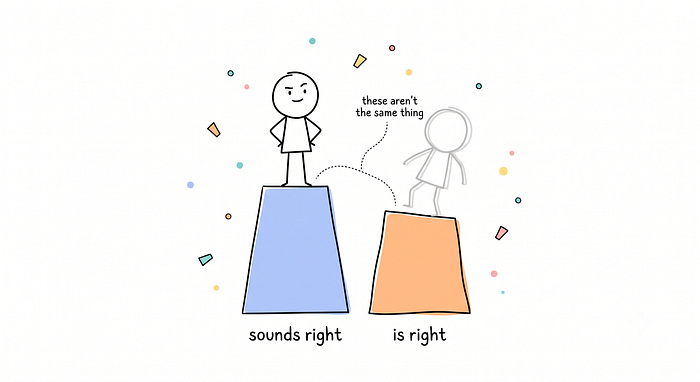
After the intro, the article explains why AI sounds confidently wrong: it works like an improv “actor” driven by next-token prediction rather than fact-checking, and it can produce plausible patterns without being accurate (fluency isn’t truth). It describes hallucination as a filling-in-the-gaps behavior shaped by settings like temperature, and shows how RLHF can encourage “yes-man” answers through reinforcement for assertiveness. It also covers limitations such as a context window that causes forgetting and a training cutoff that makes newer events go stale. The piece then offers practical ways to catch or reduce fake confidence—spotting signs like overly specific details or instant backtracking, prompting the model to say “I don’t know,” asking for critical comparisons, double-checking in a fresh chat window, and providing real documents/data (RAG-style) instead of relying on memory to guess.
Read the full blog for free on Medium.
Join thousands of data leaders on the AI newsletter. Join over 80,000 subscribers and keep up to date with the latest developments in AI. From research to projects and ideas. If you are building an AI startup, an AI-related product, or a service, we invite you to consider becoming a sponsor.
Published via Towards AI
Towards AI Academy
We Build Enterprise-Grade AI. We'll Teach You to Master It Too.
15 engineers. 100,000+ students. Towards AI Academy teaches what actually survives production.
Start free — no commitment:
→ 6-Day Agentic AI Engineering Email Guide — one practical lesson per day
→ Agents Architecture Cheatsheet — 3 years of architecture decisions in 6 pages
Our courses:
→ AI Engineering Certification — 90+ lessons from project selection to deployed product. The most comprehensive practical LLM course out there.
→ Agent Engineering Course — Hands on with production agent architectures, memory, routing, and eval frameworks — built from real enterprise engagements.
→ AI for Work — Understand, evaluate, and apply AI for complex work tasks.
Note: Article content contains the views of the contributing authors and not Towards AI.
Related posts
Recent Posts