How to Build Fault-Tolerant Enterprise AI Agents
Last Updated on July 16, 2026 by Editorial Team
Author(s): Shahidullah Kawsar
Originally published on Towards AI.
AI Engineer Interview Preparation
Click here for the full AI Engineer Prep list.
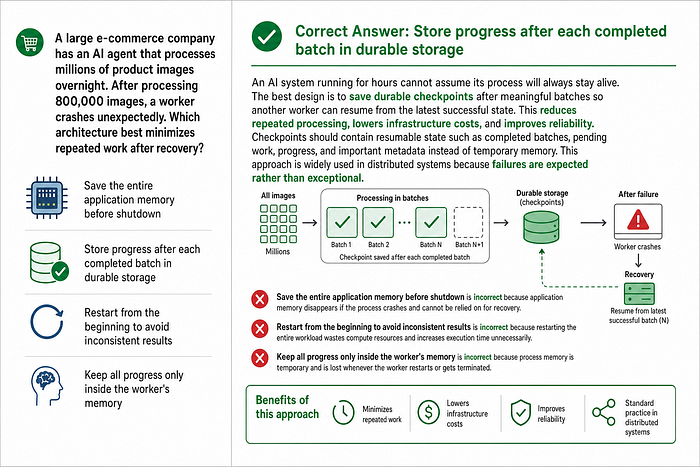
This article presents a set of fault-tolerance focused MCQs for enterprise AI agent systems, emphasizing production architectures rather than model quality alone. It walks through best practices such as saving durable checkpoints after meaningful batches, using task-IDs with asynchronous background processing for long-running jobs, summarizing older conversation history while storing full state externally, preventing duplicate business actions via idempotent operations, enforcing cost safeguards by tracking spend and stopping on budget limits, and persisting task metadata immediately so processing can resume safely after failures. It further highlights why record-level progress tracking can improve recovery, and concludes by explaining that checkpointing, progress reporting, context management, budget control, and idempotent retries are used together because they each address distinct operational failure modes that arise in long-running, distributed environments.
Read the full blog for free on Medium.
Join thousands of data leaders on the AI newsletter. Join over 80,000 subscribers and keep up to date with the latest developments in AI. From research to projects and ideas. If you are building an AI startup, an AI-related product, or a service, we invite you to consider becoming a sponsor.
Published via Towards AI
Towards AI Academy
We Build Enterprise-Grade AI. We'll Teach You to Master It Too.
15 engineers. 100,000+ students. Towards AI Academy teaches what actually survives production.
Start free — no commitment:
→ 6-Day Agentic AI Engineering Email Guide — one practical lesson per day
→ Agents Architecture Cheatsheet — 3 years of architecture decisions in 6 pages
Our courses:
→ AI Engineering Certification — 90+ lessons from project selection to deployed product. The most comprehensive practical LLM course out there.
→ Agent Engineering Course — Hands on with production agent architectures, memory, routing, and eval frameworks — built from real enterprise engagements.
→ AI for Work — Understand, evaluate, and apply AI for complex work tasks.
Note: Article content contains the views of the contributing authors and not Towards AI.
Related posts
Recent Posts