Logistic Regression: The Tutorial That Starts Where Others End
Last Updated on July 23, 2026 by Editorial Team
Author(s): Felix Pappe
Originally published on Towards AI.
Go inside the training loop and watch the model learn
If you’ve ever wondered what statistics packages and programs are doing when calculating logistic regression, this is for you.
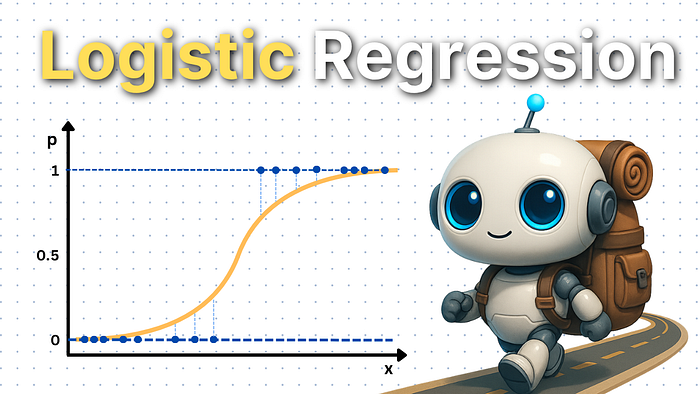
The article walks through how logistic regression turns inputs into probabilities using the sigmoid function, framing the learning problem as maximizing likelihood (and minimizing the resulting cross-entropy/binary log-loss). It then derives the gradient needed for optimization, explains how gradient descent updates model parameters iteratively using a learning rate, and connects each math step to an example “online shop” dataset. Finally, it illustrates the first parameter update and how repeating updates over many iterations makes the learned sigmoid curve better match the data, including why input standardisation improves training stability and how to convert learned parameters back to the original feature scale for interpretation.
Read the full blog for free on Medium.
Join thousands of data leaders on the AI newsletter. Join over 80,000 subscribers and keep up to date with the latest developments in AI. From research to projects and ideas. If you are building an AI startup, an AI-related product, or a service, we invite you to consider becoming a sponsor.
Published via Towards AI
Towards AI Academy
We Build Enterprise-Grade AI. We'll Teach You to Master It Too.
15 engineers. 100,000+ students. Towards AI Academy teaches what actually survives production.
Start free — no commitment:
→ 6-Day Agentic AI Engineering Email Guide — one practical lesson per day
→ Agents Architecture Cheatsheet — 3 years of architecture decisions in 6 pages
Our courses:
→ AI Engineering Certification — 90+ lessons from project selection to deployed product. The most comprehensive practical LLM course out there.
→ Agent Engineering Course — Hands on with production agent architectures, memory, routing, and eval frameworks — built from real enterprise engagements.
→ AI for Work — Understand, evaluate, and apply AI for complex work tasks.
Note: Article content contains the views of the contributing authors and not Towards AI.
Related posts
Recent Posts