What Is Retrieval-Augmented Generation (RAG)? A Complete Guide for Businesses
Last Updated on July 6, 2026 by Editorial Team
Author(s): Anthony Usoro
Originally published on Towards AI.

If you’ve spent any time with ChatGPT, Claude, or any large language model, you’ve probably run into this moment: you ask a specific question about your business, your industry, or a recent event, and the AI gives you an answer that sounds completely confident — and is completely wrong.
This isn’t a bug you can patch. It’s a structural limitation of how large language models work, and it’s the reason a growing number of businesses — especially in regulated or high-stakes sectors — are turning to an architecture called Retrieval-Augmented Generation, or RAG.
This guide explains what RAG actually is, how it works under the hood, why it matters for businesses in Nigeria and across Africa specifically, and what to watch out for if you’re evaluating a RAG system for your own organization.
The problem RAG was built to solve
A large language model (LLM) like GPT-4 or Claude is trained on a massive, fixed snapshot of text. Once training ends, that knowledge is frozen. Two problems follow from this:
- The model doesn’t know your data. It has never seen your internal policy documents, your product catalog, your customer records, or last month’s regulatory circular. If you ask about them, it has nothing to retrieve from — so it does the next best thing: it predicts what a plausible answer would look like. Sometimes that prediction is right. Often, especially on specific or technical questions, it isn’t.
- The model can’t show its work. Even when an LLM does happen to get something right, it can’t point to where that answer came from, because it isn’t “looking anything up” — it’s generating text based on statistical patterns learned during training.
Both problems are tolerable for casual use. They’re disqualifying for a bank verifying a compliance requirement, a hospital referencing a treatment protocol, or a law firm citing a contract clause. In those settings, an answer without a verifiable source isn’t useful — it’s a liability.
RAG exists to close this gap.
What RAG actually is
Retrieval-Augmented Generation is an architecture that combines two things:
- A retrieval system, which searches your own documents and data for the passages most relevant to a question.
- A generation system (the LLM), which reads those retrieved passages and uses them to write an answer — instead of relying purely on what it memorized during training.
In plain terms: instead of asking the model “what do you know about X,” you first hand it the most relevant facts about X from your own data, and then ask it to answer. The model’s job shifts from “recall a fact” to “read this evidence and summarize it accurately” — a task LLMs are dramatically better at.
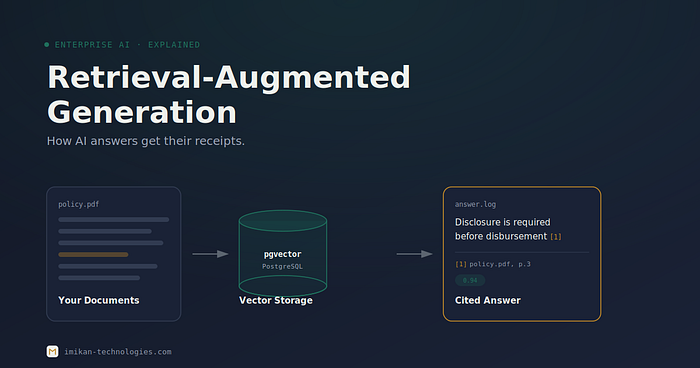
This is also why RAG answers can carry citations. Because the system knows exactly which document and passage it pulled the answer from, it can show that source alongside the response, so a human can verify it in seconds.
How a RAG system actually works, step by step
Behind the scenes, a production RAG pipeline usually has five stages:
1. Ingestion
Your documents — PDFs, Word files, spreadsheets, scanned forms, HTML pages, database records — are pulled into the system. A well-built pipeline handles messy, real-world formats, not just clean text files.
2. Chunking
Documents are broken into smaller passages, or “chunks,” because feeding an entire 200-page policy manual into a model for every question would be slow, expensive, and imprecise. This step is more delicate than it sounds. Cut a chunk in the wrong place — say, mid-clause in a legal contract — and you can silently strip out the exact detail that would have changed the answer. Good chunking preserves context; careless chunking is one of the most common, hardest-to-notice ways a RAG system quietly degrades.
3. Embedding
Each chunk is converted into a vector — a list of numbers that represents its meaning in a way a computer can compare mathematically. Chunks about similar topics end up numerically “close” to each other, even if they don’t share the exact same words. This is what allows the system to find relevant information based on meaning, not just keyword matching.
4. Storage
Each vector needs a home that can search millions of them in milliseconds — a job typically done by a vector database. A common choice is PostgreSQL with the pgvector extension, which adds vector search directly into a database most teams already run, rather than setting up a separate system. Chunks are stored alongside their vectors and source metadata (filename, page, section), which is what makes citations possible later. Keeping this on infrastructure you control, instead of a third-party vector service, is often what gets a RAG system past a bank or hospital’s security review.
5. Retrieval
When a user asks a question, that question is also converted into a vector, and the system searches the vector database for the chunks whose vectors are closest to it — in other words, the passages most likely to actually answer the question. Many production systems combine this “semantic” vector search with traditional keyword search (a “hybrid” approach), because pure vector search can occasionally miss exact terms, like a specific product code or clause number, that keyword search catches reliably.
6. Generation with citation
The retrieved chunks are handed to the LLM along with the original question, and the model is instructed to answer using only that evidence — and to reference exactly which passage supported which part of the answer. The result: an answer that’s grounded in your actual data, with a paper trail back to the source.
RAG vs. fine-tuning: two different tools
A common point of confusion is whether RAG and fine-tuning solve the same problem. They don’t.
Fine-tuning retrains a model’s internal weights on a specific dataset, which is useful for teaching a model a style, a format, or a narrow skill. It’s expensive, it’s slow to update (you have to retrain to reflect new information), and — critically — it doesn’t give you source citations, because the knowledge gets absorbed into the model’s weights rather than kept as separate, referenceable documents.
RAG leaves the model’s weights untouched and instead controls what information it sees at the moment of answering. This means:
- New documents can be added and are immediately searchable — no retraining required.
- Outdated documents can be removed just as easily.
- Every answer can be traced back to its source.
For most business knowledge-management and customer-support use cases, RAG is the more practical, more auditable, and more maintainable choice. The two approaches aren’t mutually exclusive — some systems fine-tune a model’s tone or instruction-following ability while still using RAG for factual grounding — but if your core need is “answer questions accurately from our own documents,” RAG is the architecture built for that job.
Where RAG creates real business value
Enterprise knowledge management. Instead of employees searching through shared drives or asking a colleague who’s on leave, a RAG-powered internal assistant can answer “what’s our current expense reimbursement policy” instantly, with a link to the exact policy document.
Regulated-industry compliance. In banking, legal, and healthcare, being able to answer a question and show the exact regulatory circular, contract clause, or clinical protocol that supports it isn’t a nice-to-have — it’s often a requirement for passing an audit or a client due-diligence review.
Customer support automation. A support chatbot grounded in your actual product documentation, FAQs, and past resolved tickets will consistently outperform a generic chatbot that’s guessing at answers about your specific product — and it will make far fewer of the confident, made-up claims that damage customer trust.
E-commerce and Shopify assistants. A shopping assistant that’s retrieval-grounded in your live inventory and pricing can answer “do you have this in stock” or “what’s a good laptop under a specific budget” with real, current data — not a hallucinated product that doesn’t exist.
Why this matters especially for businesses in Nigeria and Africa
Several dynamics make RAG particularly relevant for the African market right now:
- Data residency and sovereignty concerns are rising, especially in banking and government, where sending sensitive documents through opaque third-party AI services is a genuine regulatory and security concern. RAG systems can be self-hosted, keeping documents on infrastructure the business itself controls.
- Multilingual and code-switched support matters more here than in most Western markets — a well-built RAG system can be designed to understand queries in English, Pidgin, Yoruba, Hausa, or Igbo, and retrieve from documents accordingly.
- Support teams are often lean relative to customer volume. RAG-based automation lets a smaller team handle a much larger support load without sacrificing accuracy, because the system’s answers are grounded in real documentation rather than improvised.
- Trust is a competitive differentiator, not a cost center. As more African businesses evaluate AI vendors, the ones that can demonstrate verifiable answers — not just fluent ones — will have an easier time getting past procurement and compliance review, particularly with banks, hospitals, law firms, and government bodies as clients.
What to watch out for when evaluating a RAG system
If you’re assessing a RAG vendor or building one internally, a few questions separate a genuinely solid system from a fragile one:
- Does every answer cite its source? If a vendor can’t show you exactly which document and page an answer came from, you’re not getting the core benefit of RAG — you’re getting a chatbot with extra steps.
- Where does the data live? Ask whether your documents are stored on infrastructure you control, or routed through a third party you don’t have visibility into.
- How is chunking handled? This is invisible until it fails. Ask how the system avoids cutting relevant context in half, especially for structured documents like contracts or policies with numbered clauses.
- Is retrieval hybrid? A system relying purely on semantic (vector) search can miss exact terms like reference numbers or product codes. Keyword search as a complement matters more than most vendors let on.
- What happens when there’s no good answer in the documents? A well-built system should say “I don’t have information on that” rather than filling the gap with a fabricated response.
The bottom line
Retrieval-Augmented Generation isn’t a buzzword — it’s a direct architectural answer to the two biggest weaknesses of large language models: outdated knowledge and unverifiable answers. For businesses that need AI they can actually trust — knowledge teams, compliance-sensitive industries, and customer-facing automation — RAG is quickly becoming the default way to deploy AI responsibly, rather than an advanced option reserved for large tech companies.
As more African businesses adopt AI, the ones that ask “can you show me where that answer came from” — and choose systems built to answer that question — will be the ones that build durable trust with their customers, regulators, and partners.
For enquiries on this and more: visit https://www.imikan-technologies.com
Join thousands of data leaders on the AI newsletter. Join over 80,000 subscribers and keep up to date with the latest developments in AI. From research to projects and ideas. If you are building an AI startup, an AI-related product, or a service, we invite you to consider becoming a sponsor.
Published via Towards AI
Towards AI Academy
We Build Enterprise-Grade AI. We'll Teach You to Master It Too.
15 engineers. 100,000+ students. Towards AI Academy teaches what actually survives production.
Start free — no commitment:
→ 6-Day Agentic AI Engineering Email Guide — one practical lesson per day
→ Agents Architecture Cheatsheet — 3 years of architecture decisions in 6 pages
Our courses:
→ AI Engineering Certification — 90+ lessons from project selection to deployed product. The most comprehensive practical LLM course out there.
→ Agent Engineering Course — Hands on with production agent architectures, memory, routing, and eval frameworks — built from real enterprise engagements.
→ AI for Work — Understand, evaluate, and apply AI for complex work tasks.
Note: Article content contains the views of the contributing authors and not Towards AI.
Related posts
Recent Posts