

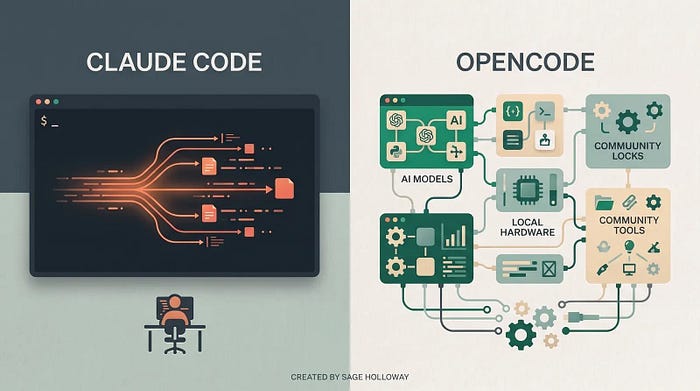
OpenCode vs Claude Code: The Complete Terminal AI Alternatives Guide (2026)
Author(s): Sage Holloway 🍓 Originally published on Towards AI. OpenCode vs Claude Code: The Complete Terminal AI Alternatives Guide (2026) Managed Claude Code vs open terminal harnesses: Tool Search, LSP loops, token economics, and when to pick OpenCode. Terminal-first AI development has …

Tool Call Orchestration: Sequential, Parallel, and DAG Execution
Author(s): Armin Norouzi, Ph.D Originally published on Towards AI. Tool Call Orchestration: Sequential, Parallel, and DAG Execution A research agent calling 6 tools sequentially waits 1,832ms at P50. The same 6 tools run in parallel — ignoring all dependencies — finish in …
Choosing Claude Model and Effort Level in Claude Code
Author(s): Udaykiran Estari Originally published on Towards AI. The Wrong Question Is ‘Which Claude Model Should I Use?’ The fastest way to waste money in Claude Code is not picking the expensive model. It is leaving effort unconstrained, watching a normal coding …
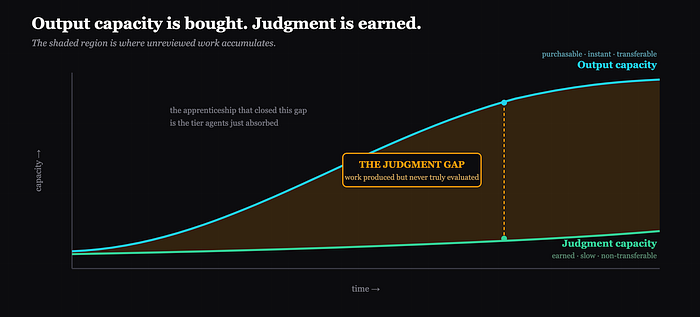
Everyone Got Faster. Nobody Got Better at Judging. That Gap Is the Whole Problem.
Author(s): Siddhant Nitin Patil Originally published on Towards AI. The most important sentence I read this month was buried in a product newsletter on August 14, and it was not presented as a finding. It was presented as an aside. AI is …

AgentFence: A Local MCP Policy Firewall for AI Agent Tool Calls
Author(s): Diogo Santos Originally published on Towards AI. Your coding agent can now touch your filesystem, GitHub, and shell. AgentFence is a single Go binary that decides allow, deny, or ask before any of it runs — no cloud, no telemetry. Your …
Stop Building AI Apps for Every Idea. Start Building MCP Servers — Part #7
Author(s): Andrii Tkachuk Originally published on Towards AI. Stop Building AI Apps for Every Idea. Start Building MCP Servers — Part #7 In Part #1, I argued that the UI is increasingly becoming the shell while MCP servers become the capability layer. …

Your Agent Didn’t Hallucinate. Your Architecture Laundered a 0.51.
Author(s): Zenefa Rahaman, PhD Originally published on Towards AI. Your Agent Didn’t Hallucinate. Your Architecture Laundered a 0.51. Probabilistic systems are useful precisely because they are not fully deterministic. A language model can interpret an underspecified request, generate several plausible plans, and …

DeepSeek Harness vs Claude Code: A Plugin Architecture Teardown
Author(s): Udaykiran Estari Originally published on Towards AI. Stop comparing marketing pages. We swapped the models underneath both agent harnesses to isolate the architecture from the hype. Every launch-week take treats the new DeepSeek Harness versus Claude Code as a proxy war …

Capability Tokens for AI Agents: A Security Kernel in Python
Author(s): Diogo Santos Originally published on Towards AI. Your agent has 1,000 tools and no idea which ones it’s allowed to call. agent-kernel gives every tool call an HMAC capability token, a policy gate, and a tamper-evident audit trail — in-process, in …

Agentic Finetuning: Your Data Knows Things Nobody in Your Company Knows
Author(s): Hamiz Ahmed Originally published on Towards AI. A company’s memory: thousands of documents that together know things no single person does. (Image: AI generated) A machine manufacturer I worked with has roughly 900 service reports. Somewhere in that pile sits the …
Why Your GPU’s Memory Ceiling Is the Best Cloud Cost Forecast You Have
Author(s): “The AI Engineer” Originally published on Towards AI. Every developer who has tried to run a 70B model on a single GPU has hit the same wall. The model looks fine on paper. The benchmarks look great. Then you load it …

The Future of Engineering Design Is Agentic
Author(s): Dr. Axel Richter Originally published on Towards AI. The Future of Engineering Design Is Agentic The next CAD revolution is not a better text box. It begins when an AI system understands a design goal, independently selects the right tools, changes …

ChainWeaver: Compile Deterministic Agent Tool Flows, No LLM Between Steps
Author(s): Diogo Santos Originally published on Towards AI. Your agent keeps re-deciding the same tool path on every turn. Compile it once into a typed, LLM-free flow — and watch the data-corruption rate drop from 61–96% to 0%. Your agent works. It …

Does Your AI Know When It Might Be Wrong?
Author(s): Nadia Sheikh Originally published on Towards AI. Beyond Accuracy · Model Evaluation (#4) This is what building an honest evaluation layer taught me. Right now it runs on a synthetic staging model — I generate the patients, so I know the …

Debugging Autonomous Agents in Production
Author(s): Udaykiran Estari Originally published on Towards AI. Debugging Autonomous Agents in Production When a traditional microservice fails, you get a stack trace. When an autonomous agent fails, you get a polite hallucination that confidently executes the wrong state transition. The era …
Recent Posts


