Anthropic’s Fable 5 Was The Warning, OpenAI’s GPT 5.6 Was The Confirmation, Will All Frontier Releases Now Be Restricted By The US Goverment?
Last Updated on July 6, 2026 by Editorial Team
Author(s): Caspar Bannink
Originally published on Towards AI.
Anthropic’s Fable 5 Was The Warning, OpenAI’s GPT 5.6 Was The Confirmation, Will All Frontier Releases Now Be Restricted By The US Goverment?
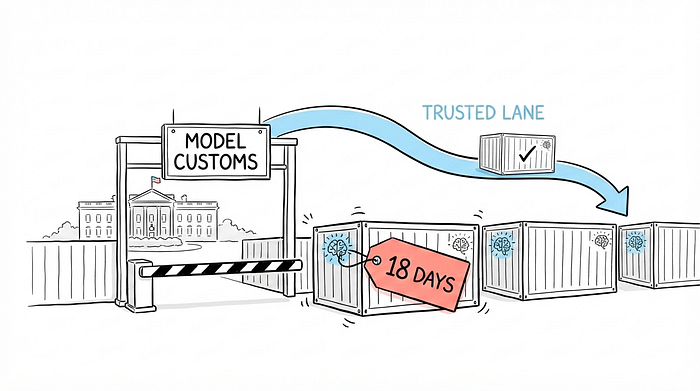
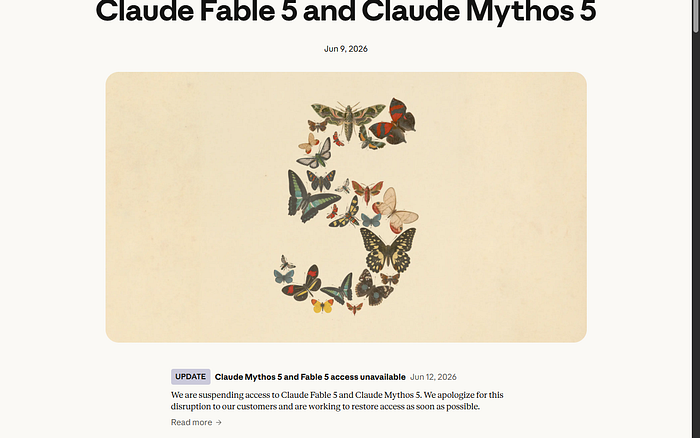
Anthropic launched Claude Fable 5 and Mythos 5 on June 9, 2026 (anthropic.com/news/claude-fable-5-mythos-5). Three days later, on June 12 at 5:21pm ET, a US government export control directive landed and Anthropic disabled both models for every customer, not just foreign ones (anthropic.com/news/fable-mythos-access). The next week, on June 26, OpenAI launched GPT-5.6 Sol in a “limited preview” with general availability “in the coming weeks” (openai.com/index/previewing-gpt-5–6-sol). Two frontier labs, two flagship launches, both gated on a US government process that did not exist before either of them shipped.
The article argues that the June 2026 releases from Anthropic (Claude Fable 5/Mythos 5) and OpenAI (GPT-5.6 Sol) illustrate a broader, repeatable pattern: frontier model availability is becoming governed by US government processes that can quickly restrict or delay access after launch. It distinguishes the triggers—Anthropic’s was an export-control action that forced models offline, while OpenAI’s was a limited preview coordinated with government ahead of launch—but emphasizes that for builders the practical impact is similar: announcements are unreliable, general availability may come weeks later (or not at all), timelines are not publicly known, access can be retroactively restricted, and preview vs. GA should be treated as different products. The author further explains that “capability thresholds” are effectively set via the labs’ own preparedness-framework tiers, while access/timing decisions are controlled by government, producing an opaque coordination regime. The takeaway for developers is to plan for 4–12 week delays, build multi-provider fallback routing, assume at most ~72 hours after directives become public, and prepare operationally for restricted rollouts that lack transparent published frameworks, appeal paths, or consistent enforcement rules.
Read the full blog for free on Medium.
Join thousands of data leaders on the AI newsletter. Join over 80,000 subscribers and keep up to date with the latest developments in AI. From research to projects and ideas. If you are building an AI startup, an AI-related product, or a service, we invite you to consider becoming a sponsor.
Published via Towards AI
Towards AI Academy
We Build Enterprise-Grade AI. We'll Teach You to Master It Too.
15 engineers. 100,000+ students. Towards AI Academy teaches what actually survives production.
Start free — no commitment:
→ 6-Day Agentic AI Engineering Email Guide — one practical lesson per day
→ Agents Architecture Cheatsheet — 3 years of architecture decisions in 6 pages
Our courses:
→ AI Engineering Certification — 90+ lessons from project selection to deployed product. The most comprehensive practical LLM course out there.
→ Agent Engineering Course — Hands on with production agent architectures, memory, routing, and eval frameworks — built from real enterprise engagements.
→ AI for Work — Understand, evaluate, and apply AI for complex work tasks.
Note: Article content contains the views of the contributing authors and not Towards AI.
Related posts
Recent Posts