
7 AI Agent Cost Optimization Strategies That Cut LLM Bills by Up to 90%
Last Updated on July 20, 2026 by Editorial Team
Author(s): Divy Yadav
Originally published on Towards AI.
Fixes that bring an AI agent’s bill down in production
AI got 80% cheaper this year.
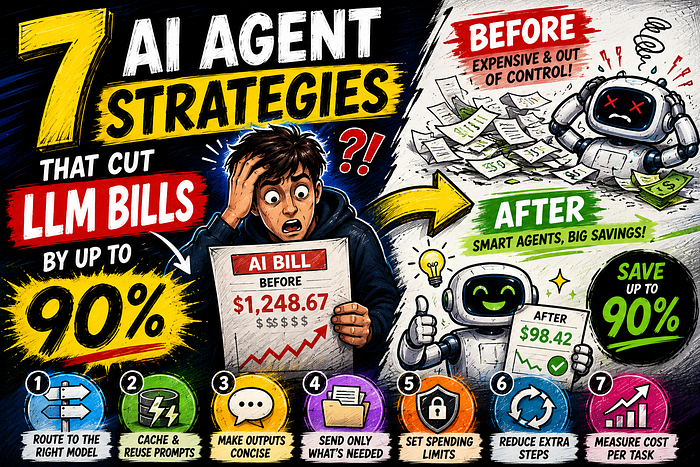
After the lead, the article explains why cheaper token pricing doesn’t guarantee cheaper agent systems: agents read and generate far more tokens than a single prompt, because they plan, call tools, loop, and perform multiple hidden steps. It then outlines seven production-focused cost fixes—route simple steps to smaller models, avoid re-sending the same context by using prompt caching, constrain output length/format so the agent doesn’t write essays, keep prompts focused by trimming unnecessary history and document dumps, add spending limits with a “circuit breaker,” measure and reduce the number of agent “thinking” calls per task, and track cost per finished job rather than raw token counts. The takeaway is that bills rise when teams stop checking what the agent actually does per call, so cost control comes from observing and managing the agent’s end-to-end behavior.
Read the full blog for free on Medium.
Join thousands of data leaders on the AI newsletter. Join over 80,000 subscribers and keep up to date with the latest developments in AI. From research to projects and ideas. If you are building an AI startup, an AI-related product, or a service, we invite you to consider becoming a sponsor.
Published via Towards AI
Towards AI Academy
We Build Enterprise-Grade AI. We'll Teach You to Master It Too.
15 engineers. 100,000+ students. Towards AI Academy teaches what actually survives production.
Start free — no commitment:
→ 6-Day Agentic AI Engineering Email Guide — one practical lesson per day
→ Agents Architecture Cheatsheet — 3 years of architecture decisions in 6 pages
Our courses:
→ AI Engineering Certification — 90+ lessons from project selection to deployed product. The most comprehensive practical LLM course out there.
→ Agent Engineering Course — Hands on with production agent architectures, memory, routing, and eval frameworks — built from real enterprise engagements.
→ AI for Work — Understand, evaluate, and apply AI for complex work tasks.
Note: Article content contains the views of the contributing authors and not Towards AI.
Related posts
Recent Posts